Same player, same frequency. What if the biggest barrier to tennis isn’t skill—but cost? Why does tennis cost thousands more than padel?
At first glance, tennis doesn’t look unreasonable. A court here, a restring there. And in many European clubs, it even feels accessible—outdoor courts are often included in membership during the summer months.
But stack it over a full year and it adds up differently than most people expect.
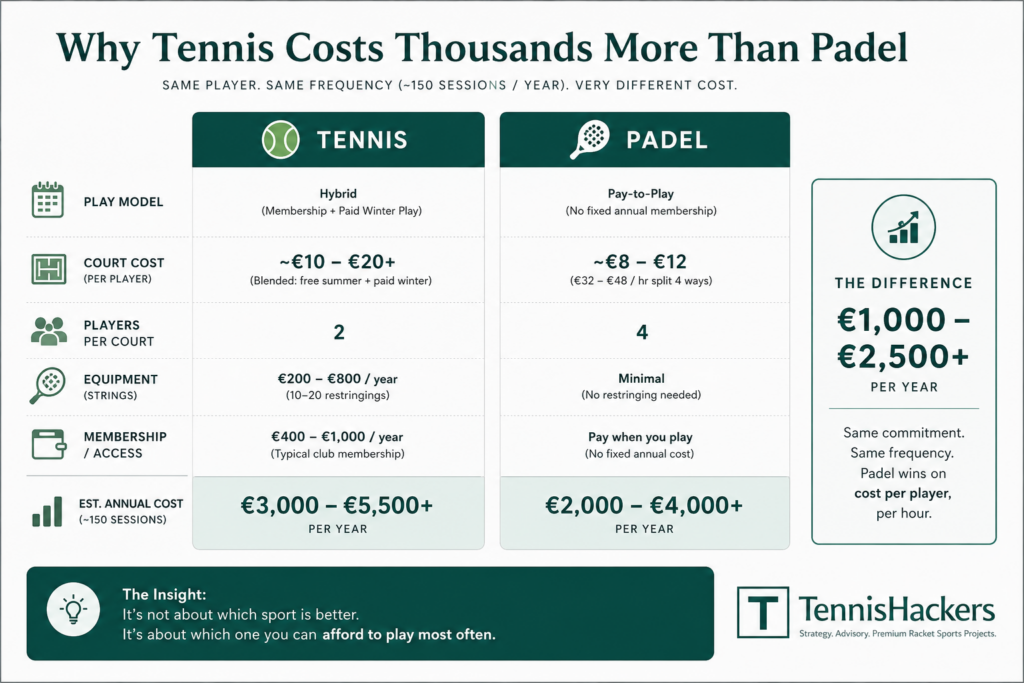
A committed player training ~3x per week (~150 sessions) will typically split their year in two. Summer play is often “free” (covered by membership), but winter is a different story. Indoor courts, peak-hour bookings, and lights become unavoidable.
Assume roughly half your sessions move indoors. At €20–€40 per hour, split between two players, that’s still around €1,200–€2,000 per year in court-related spend. Add membership on top (€400–€1,000), and suddenly the baseline cost of just showing up is already meaningful.
Padel flips that entirely.
The court is often more expensive—€32–€48 per hour—but it’s almost always doubles. Split four ways, and the cost per player typically lands around €8–€12 per session. Over a full year of similar frequency, that translates to roughly €1,200–€1,800 in total court spend.
And crucially, most padel facilities operate on a pay-to-play model. No fixed annual membership. You pay when you play. Same commitment, but consistently shared. That’s not pricing. That’s structure.
And it doesn’t stop there. Tennis taxes you through strings. At an advanced level, restringing 10–20 times a year at €20–€40 each becomes a meaningful line item. Padel avoids that category. Different trade-offs, but fewer recurring costs.
When you zoom out:
Tennis: roughly €3,000–€5,500+ per year
Padel: roughly €2,000–€4,000+ per year
But I think the more interesting point isn’t that padel is cheaper. It’s why.
Padel has engineered affordability into the experience. Doubles as the default. Higher court utilisation. Social by design. It reduces the cost per player, per hour in a way tennis simply doesn’t.
Tennis, on the other hand, is still built around a more individual model—one court, fewer players, longer sessions. Great for performance but less efficient economically.
Padel has grown, driven largely by accessibility and ease of play ….meanwhile, tennis participation studies continue to highlight cost and court availability as key barriers, particularly for frequent play.
We tend to talk about racket sports growth in terms of culture and trends. But underneath it all, there’s a simpler driver: cost per hour of play. Padel (and Pickleball) didn’t just arrive at the right time. It arrived with a better economic model.
And if tennis wants to compete long-term, it may need to rethink more than just formats and scoring. In the end, many people don’t choose the best sport but the one they can afford to keep playing.
(Originally published on LinkedIn)