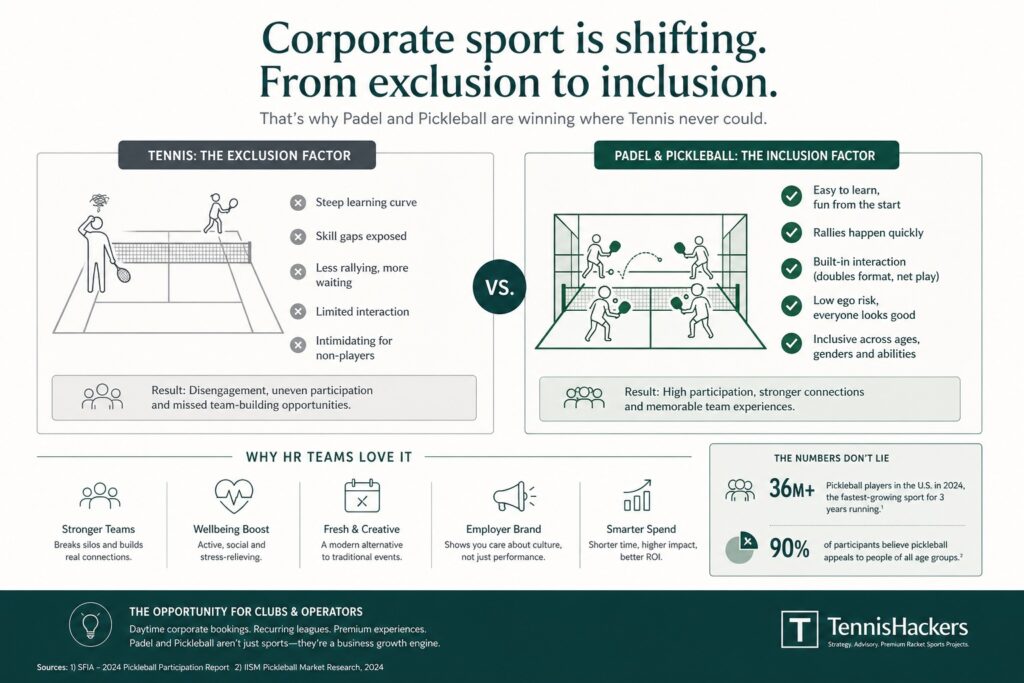
Corporate tennis never really worked. Different result in pickleball and padel?
I’ve seen it too many times: you get 12 colleagues on court for a “team-building” session. Two can actually play. Three are decent. The rest spend most of the hour apologising for missed balls, chasing shots into the fence, tripping over their own feet and quietly wishing it was over.
That’s not team building. That’s quiet disengagement.
And yet, put the same group on a padel or pickleball court, and the dynamic flips almost instantly. Within 10 minutes, rallies are happening. People are laughing. Conversations start mid-point at the net. The pressure disappears.
That’s not an accident: whilst tennis exposes skill gaps brutally, padel and pickleball hide them just enough to keep everyone involved.
The smaller courts, the doubles format, the softer learning curve… they create something tennis rarely can in a corporate setting: immediate inclusion.
And that’s exactly what HR departments are buying… they’re not interested in forehands and backhands. They’re measured on engagement, culture, and participation. If 20 employees show up, they need 20 employees to feel part of the same experience.
There’s data backing this shift. Pickleball, for example, has exploded to over 36 million players in the U.S. alone, making it the fastest-growing sport for multiple consecutive years (SFIA). At the same time, internal surveys show nearly 90% of participants believe it appeals across age groups—something very few sports can claim.
That matters in a workplace where teams are increasingly mixed across generations, roles, and physical ability.
And Padel follows a similar trajectory in Europe—less about elite performance, more about shared experience.
There’s also a more subtle factor at play: ego risk. Corporate environments are political ecosystems. People avoid situations where they might look incompetent in front of colleagues or managers. Tennis, unintentionally, creates exactly that scenario. Padel and pickleball soften it. Everyone looks “good enough” quickly. Mistakes are less exposed. The barrier to entry is low, but the social reward is high.
And then there’s the networking angle. Companies are gravitating toward shorter, more dynamic formats—60 to 90 minutes of play, high rotation, constant interaction.
From a business perspective, this is where it gets interesting. Clubs and operators who understand this aren’t just offering courts. They’re packaging experiences: coached sessions, mini-tournaments, food, drinks, repeat leagues. What looks like a sport trend is actually a B2B revenue channel hiding in plain sight.
But—and this is important—it only works if executed well. Poorly run sessions, no structure, no host… the whole thing falls apart quickly. So, the opportunity is real. But it’s not automatic.
(Originally published on LinkedIn)