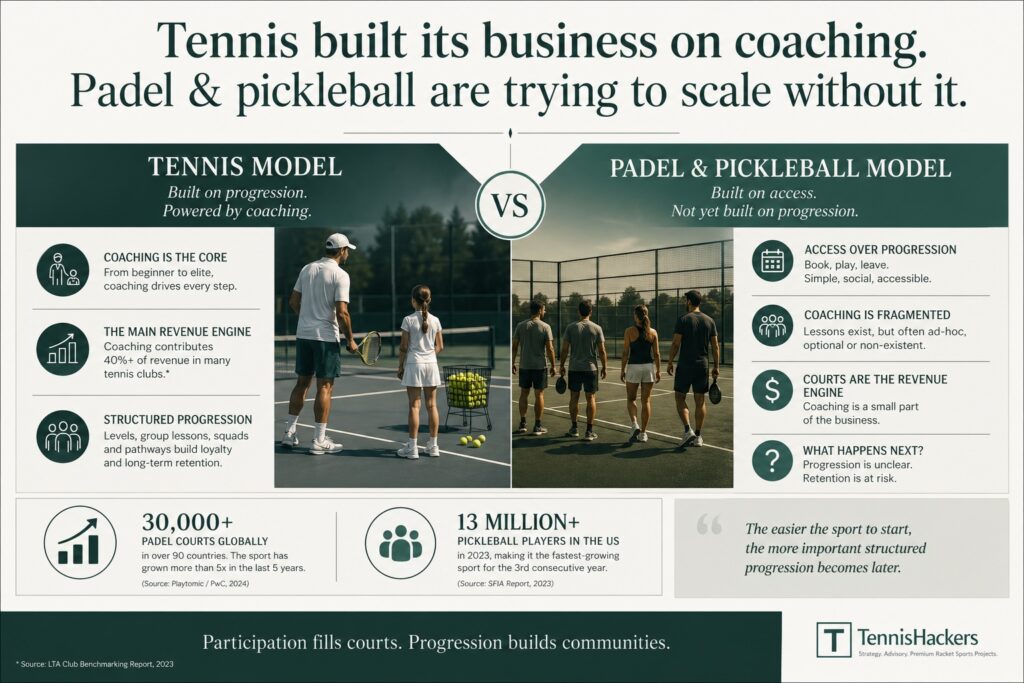
Tennis built its business on coaching. Padel and pickleball are trying to scale without it. Why?
You dont have to be a hero to fill up Padel and Pickleball facilities currently – both sports are booming: courts are full, the energy is high, new players are arriving daily. But underneath the surface, something is structurally thin.
In tennis, coaching is not an accessory. It is the framework the sport runs on.
Walk into a traditional club and you rarely see courts as the main product. Tennis experience is structured around progression. Juniors moving through squads. Adults in structured group lessons. Private sessions filling gaps between bookings. Holiday camps anchoring school breaks. Coaching is not optional — it is the system that holds participation together.
In many tennis environments, coaching contributes a significant share of revenue, often estimated at 40% or more depending on club structure (LTA club benchmarking data, 2023). Courts generate activity, but coaching generates continuity.
Padel and pickleball have taken a different path.
Padel now exceeds 30,000 courts globally, driven largely by Europe and the Middle East (Playtomic / PwC estimates, 2024). Pickleball participation in the United States passed 13 million players in 2023, marking its third consecutive year as the country’s fastest-growing sport (SFIA report).
The scale is massive and, admitedly, the structure is still evolving and figuring things out.
However, in both sports, the dominant commercial model remains simple: book a court and play. Coaching exists, but often at the margins — introductory clinics, occasional private lessons, informal advice exchanged between games.
I see it repeatedly in emerging venues. Beginners improve quickly in their first sessions – they think “I got this – no need for lessons”. The sports are accessible enough to reward instinct and wild swings in the dark. But then comes a plateau. Not because the games lack depth, but because there is no clear progression system guiding players forward.
Tennis does not allow that gap to linger. From the beginning, players are placed into levels, groups, and coaching environments that define their next step before they even realise they need one.
Padel and pickleball, by contrast, still rely heavily on self-directed learning and social repetition.
That works — up to a point. But it also creates a inefficiency. Venues are busy, yet player development is fragmented. Engagement is high, but loyalty is less structured than it appears.
Coaching is present, but not yet institutionalised. It exists as an activity, not as an operating model.
Perhaps that is the real question emerging for these sports: not whether coaching is needed, but why it is needed.
Right now, participation is scaling faster than progression….that imbalance will not stay invisible for long.
(Originally published on LinkedIn)