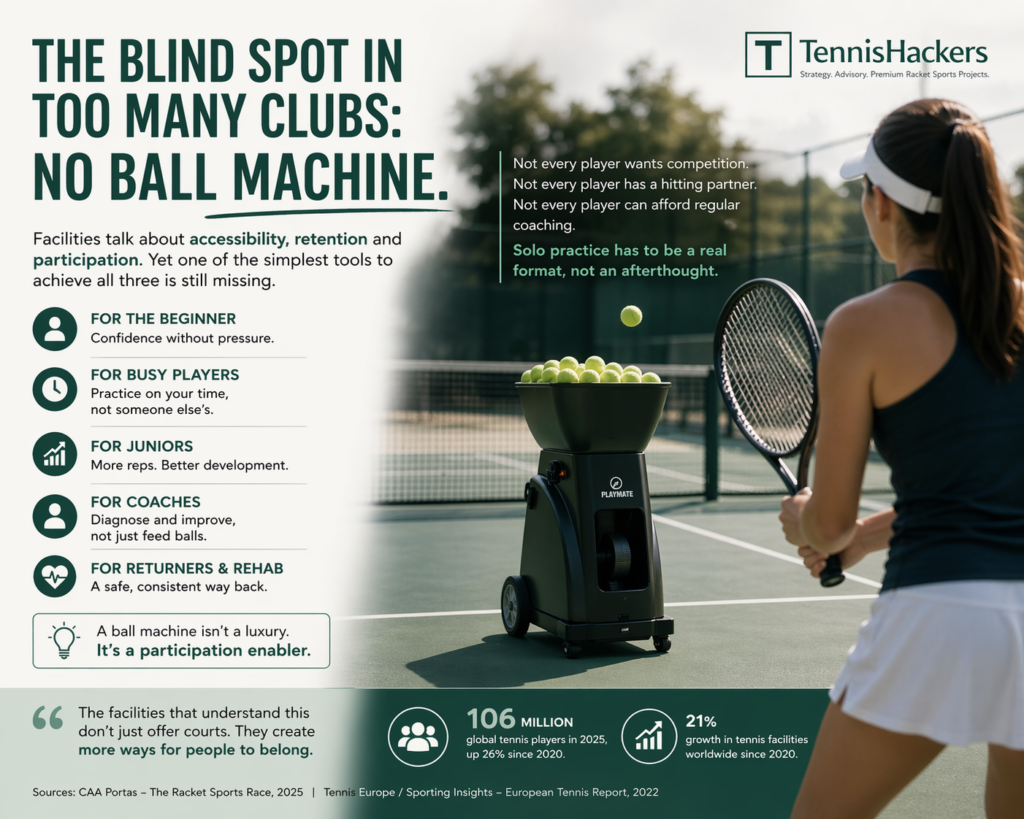
Rackets facilities talk endlessly about participation growth, retention and accessibility. Then many still fail to provide the simplest, most basic solo-training tool in the building: a ball machine.
That may sound like a small operational gripe – it’s not… it says something bigger about how many clubs still misunderstand what modern participation actually looks like.
Over the years, I have spent a lot of time around facilities that were full of good intentions. They wanted more beginners, better retention, stronger coaching programmes, more flexible usage, more reasons for members to come back. But then you looked at the actual offer and realised that everything still depended on the same old formula: find a partner, find a coach, find a time that suits both, and only then can you really play.
That model leaves a lot of people behind.
A ball machine solves more of those problems than most facilities realise. It gives the nervous beginner a way to hit balls without feeling judged, the returning player a bridge back into the sport, juniors the repetition they need, coaches the chance to spend more time observing and correcting instead of endlessly feeding by hand. And it gives a member with one spare hour on a Tuesday afternoon a reason to come to the club instead of staying home.
That matters more now than it did 15 years ago. According to the CAA Portas 2025 Racket Sports Report, global tennis participation reached 106 million players in 2025, up 26% since 2020. At the same time, tennis facilities grew by 21% over that period. In other words, participation is growing, but pressure on courts, programming and user experience is growing too. Facilities cannot keep saying they want more people in the game while ignoring one of the simplest tools for making the game easier to access.
And retention matters just as much as recruitment. The Tennis Europe / Sporting Insights report 2022 made that point well: participation growth is not only about bringing people in, but about keeping them in. That has always matched what I have seen myself. Players do not drift away only because they stop loving tennis but because the sport becomes inconvenient.
I have worked in enough clubs to know that our industry can sometimes spend too much money on things that look progressive and not enough on things that are actually useful. A ball machine is not glamorous. It does not make for sexy launch content. But in practical terms, it may do more for flexibility, confidence and repeat usage than half the “innovation” discussions I hear.
If a facility (and that includes Padel and Pickleball.. not just Tennis) says it wants to grow participation, but still gives people no easy way to practise alone, I cannot help thinking the strategy is incomplete. Or, to put it more bluntly, the club is missing the point a little bit.
(Originally published on LinkedIn)