If you’re judging a sport purely by how many calories it burns, you’re already asking the wrong question.
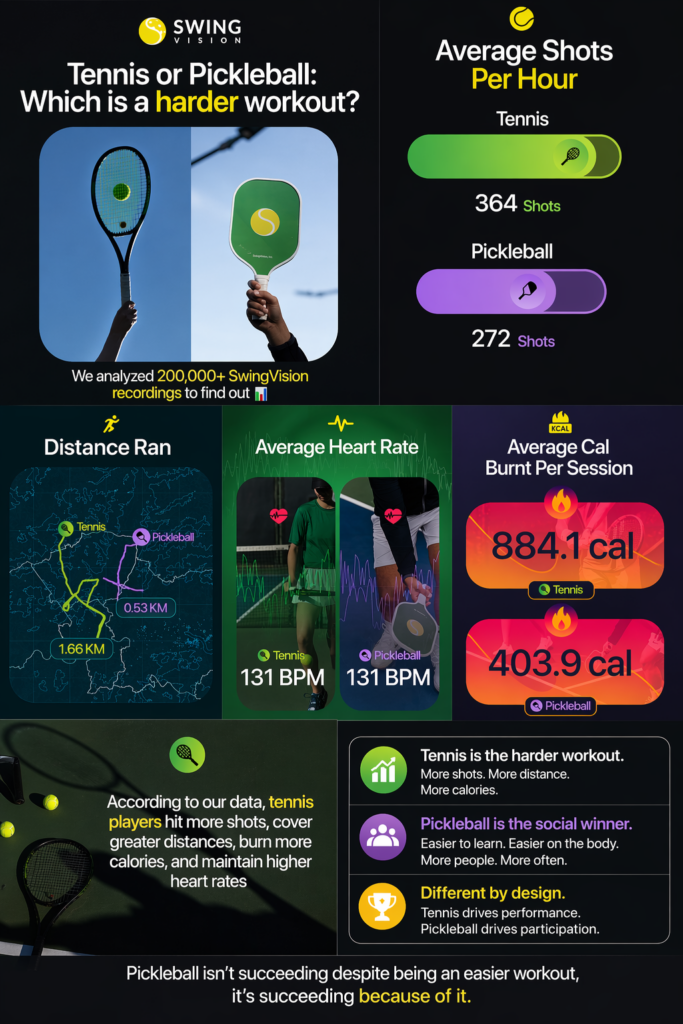
I saw a recent analysis from SwingVision own data comparing tennis and pickleball using over 200,000 match recordings. The conclusion was predictable: tennis players hit more shots (364 vs 272 per hour), cover significantly more ground (1.66 km vs 0.53 km), and burn more than double the calories (884 vs 404 per session).
So yes—tennis is clearly the harder workout.
And that’s exactly why I’ll probably never switch.
I play tennis because of that physical demand. I like walking off court knowing I’ve been pushed, that I’ve earned it. That feeling is hard to replicate. But I also fully accept that I’m in the minority. Most people are not chasing exhaustion… they’re chasing enjoyment, connection, and something they can sustain week after week.
That’s where pickleball wins: from personal observation, I have noticed that the courts that fill up fastest are rarely the ones that demand the most physically—they’re the ones that feel the most accessible. Pickleball removes friction. It’s easier to learn, less taxing on the body, and far less intimidating to walk into for the first time.
And that’s not just anecdotal: in the U.S. alone, pickleball has reached around 36 million active players, largely driven by its accessibility and social nature . And when nearly 90% of people believe it appeals to a wider age range, you start to see why adoption accelerates the way it has.
There’s another layer here that often gets missed.
The average heart rate in both sports sits at around 131 BPM – this, in my opinion was the most interesting and revealing stat. In other words, people are exerting themselves similarly… just in very different environments. Tennis stretches you across space. Pickleball compresses the experience—less distance, more interaction, more continuity.
That’s hugely important: there are literally millions of people who are not physically capable—or simply not willing—to run the distances required in tennis. Pickleball doesn’t just accommodate them, it invites them in. And once they’re in, they stay, they bring friends and play again tomorrow. That flywheel is incredibly powerful, and very hard to replicate in more demanding sports.
Which brings us to the real point.
Pickleball isn’t succeeding despite being an easier workout… it’s succeeding because of it. It optimizes for participation, not performance. For repeatability, not intensity. For community, not just competition.
Tennis will always dominate at the top of the pyramid. But pickleball is building the base—and in this industry, the base is where everything starts.
That shift is happening faster than most people realize, and I think many are still underestimating just how big that base can become. Bigger than padel will become?
(Originally published on LinkedIn)