The most dangerous assumption in racket sports right now is that staff-less facilities are a real business.
Over the past months, I’ve seen a growing wave of such venues positioning themselves as “efficient”, “lean”, even “future-proof.” No coaches, no front desk, no human layer. Just courts, access codes, and a booking system.
On paper, it looks brilliant: strip out payroll, reduce complexity, maximize margins. But it completely misunderstands what people are actually paying for.
After decades in this industry, across clubs and resorts, I’ve learned something the hard way: courts don’t build businesses — people do. The best-performing facilities I’ve worked with were never the ones with the lowest cost base. They were the ones that created energy, programming, introductions, and a smiling face somewhere. A sense that something was always happening, even if you came alone.
Whether you want to believe it or not, racket sports are a social system and not transactional.
Data supports this more than most operators realise. In a recent pickleball development study, 75.7% of players said they discovered the sport through friends, not marketing or platforms (IISM / @AIPA report). That’s not a funnel — that’s a network. Remove the human connectors, and you weaken the entire growth engine.
At the same time, participation behaviour tells another story. Nearly 80% of respondents play either rarely or never, despite awareness of the sport (same report). That gap isn’t solved by more courts. It’s solved by onboarding, coaching, and community — all things staffless models eliminate.
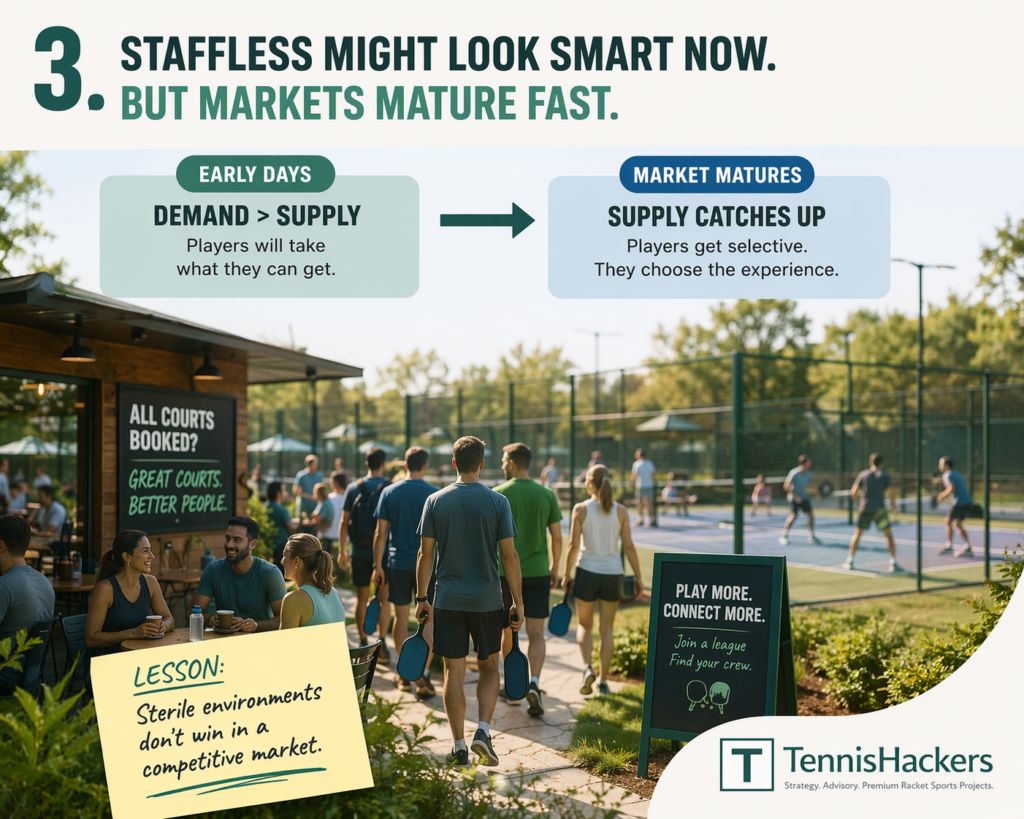
Right now, these venues are being carried by a simple reality: demand in many places still outstrips supply. Players will accept almost any court with a net. But that phase never lasts. I saw it in tennis. We saw it in padel markets like Sweden. The moment supply catches up, players become selective. And sterile environments don’t win that battle.
There’s also a more subtle issue. Without staff, you lose your feedback loop. You don’t see who’s dropping out. You don’t hear the complaints. You don’t spot the friction points that kill retention. You’re running a participation business without actually understanding participation.
And then there’s the ceiling. No staff means no coaching revenue, no events, no F&B activation, no corporate bookings. You’ve reduced your costs, yes. But you’ve also capped your upside. You’ve built a ceiled asset, not a business.
I’m not saying these models will fail tomorrow. In fact, many will look successful in the short term, and some operators will point to strong early utilisation as proof that it works. But structurally, they are limited. And those limitations will become very visible as soon as the market matures.
The real opportunity in racket sports isn’t efficiency. It’s belonging….that’s something you can’t automate, at least not yet.
(Originally published on LinkedIn)