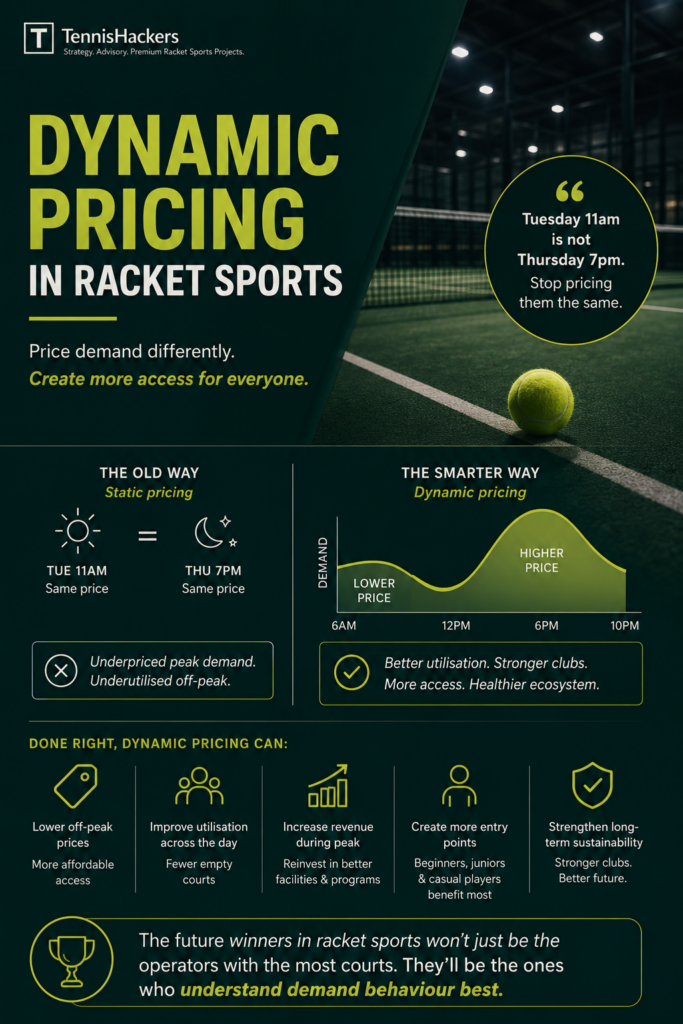
The racket sports industry still prices courts as if every booking-hour carries the same value. It doesn’t and therefore it shouldn’t.
And I think that’s becoming one of the biggest operational blind spots in tennis, padel and pickleball.
Over the years, I’ve spent a lot of time around clubs, resorts and racket sports operators trying to solve what is essentially the same recurring problem: packed courts at certain hours… and underused infrastructure at others.
Ironically, many facilities experiencing “high demand” are still struggling financially.
That should tell us something.
A few years ago, one of our partner resorts increased indoor winter court pricing during premium evening hours. What interested me most wasn’t the backlash or even the drop in bookings but how differently various player groups reacted: Singles participation proved highly price-sensitive whilst Doubles participation was far more resilient.
That observation completely changed the way I started thinking about court demand.
Because operators often treat all court bookings as interchangeable inventory when they clearly are not. Some players are booking for exercise, others for competition, others for social interaction, others simply because 7pm after work is the only realistic slot available to them.
Different motivations. Different elasticity. Yet the industry still largely operates on static pricing models: Tuesday 11am = Thursday 7pm. Same price. Same product. Except it isn’t the same product at all.
The hospitality and airline industries moved beyond this thinking decades ago. They learned that pricing is not just about maximizing revenue. It’s about distributing demand more intelligently across finite inventory.
And I suspect racket sports are slowly heading in the same direction, not because clubs suddenly want to become greedy, but because many operators are now facing the same rental, staffing, energy, overhead cost rise pressures:
Meanwhile, participation continues to rise. According to the SFIA, pickleball participation in the US grew more than 150% over a three-year period, while padel expansion across Europe and the Middle East continues at an extraordinary pace.
So if demand is increasing faster than many facilities can adapt, than Dynamic Pricing – done intelligently – can improve access (done badly and it becomes extraction): lower off-peak pricing = better utilisation across the day = more affordable entry points for beginners = less strain on peak-hour congestion = stronger long-term facility sustainability.
The future winners in racket sports probably will be those who understand demand behaviour best, instead of just building a lot of courts.
And honestly, I think large parts of the industry still haven’t fully realised that yet.
(Originally published on LinkedIn)