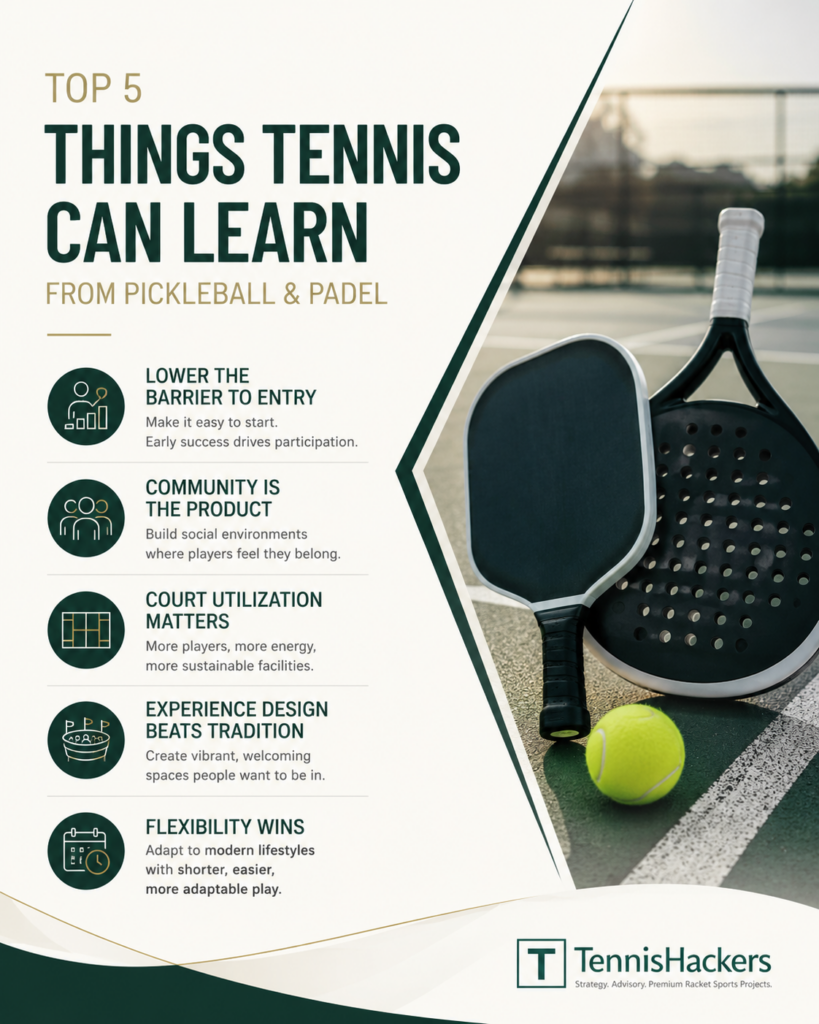
Many in the tennis industry view pickleball and padel as threats. That’s a lost opportunity. If you’re smarter, you’ll be asking : why are these sports growing so quickly?
Here are my 5 lessons that tennis should pay attention to:
1. Lower The Barrier To Entry:
Pickleball and padel deliver immediate enjoyment. Nothing new here. Beginners can rally quickly and feel successful fast.
Tennis is perceived as needing significant technical development before players fully enjoy the game. That is not true: you can pick up the basics much quicker than we are lead to believe and we need to train coaches to make tennis accessible.
2. Community Is The Product:
Pickleball and padel built strong social cultures: open play, doubles formats, informal interaction and welcoming environments.
Many tennis environments still feel too formal or intimidating for casual players. The hard truth is that the tennis community in general is less welcoming of strangers and newbies than other racket sports.
3. Court Utilization Matters:
Modern facilities increasingly prioritize participation density, atmosphere, repeat traffic, commercial sustainability. Padel and pickleball often generate more activity and energy per square meter than traditional tennis setups.
That economic reality matters….according to CAA Portas analysis, converted padel and pickleball spaces can generate roughly 3x–7x higher daily revenue potential than traditional single-court tennis configurations.
That’s one of the main reasons operators worldwide are increasingly moving toward hybrid racket sport facilities.
4. The Experience Beats The Tradition:
Successful padel and pickleball venues feel alive: movement, spectators, music, social spaces. Too many tennis venues still operate around older consumer expectations that work well for committed players whilst the broader sports and leisure industry has already evolved toward entertainment, hospitality integration, community-centric design, flexible participation spaces
Racket sports are not exempt from those shifts.
5. Flexibility Wins
Modern consumers want shorter sessions, easier scheduling, less physical strain, lower commitment barriers. Padel and pickleball adapted naturally to modern lifestyles whilst tennis has been slower to evolve. It needs to be noted that growth usually comes from casual and semi-casual consumers.
The sports growing fastest today are often the ones fitting most naturally into fragmented modern lifestyles.
Tennis does not need to become pickleball or padel.
But it does need to understand why those sports are expanding so rapidly in participation, accessibility, commercial energy and cultural relevance.
I believe that the biggest threat to tennis may not be competing racket sports but its own resistance to evolution.
Any other lessons?
(Originally published on LinkedIn)