You can tell almost everything about a rackets facility without ever stepping on court — just read its price list.
Just as a good accountant can judge a company’s health from its balance sheet, you can assess the strategy, priorities, and even the culture of a racket facility operation simply by analysing how it prices its services. A price list is never just numbers. It’s a philosophy in disguise.
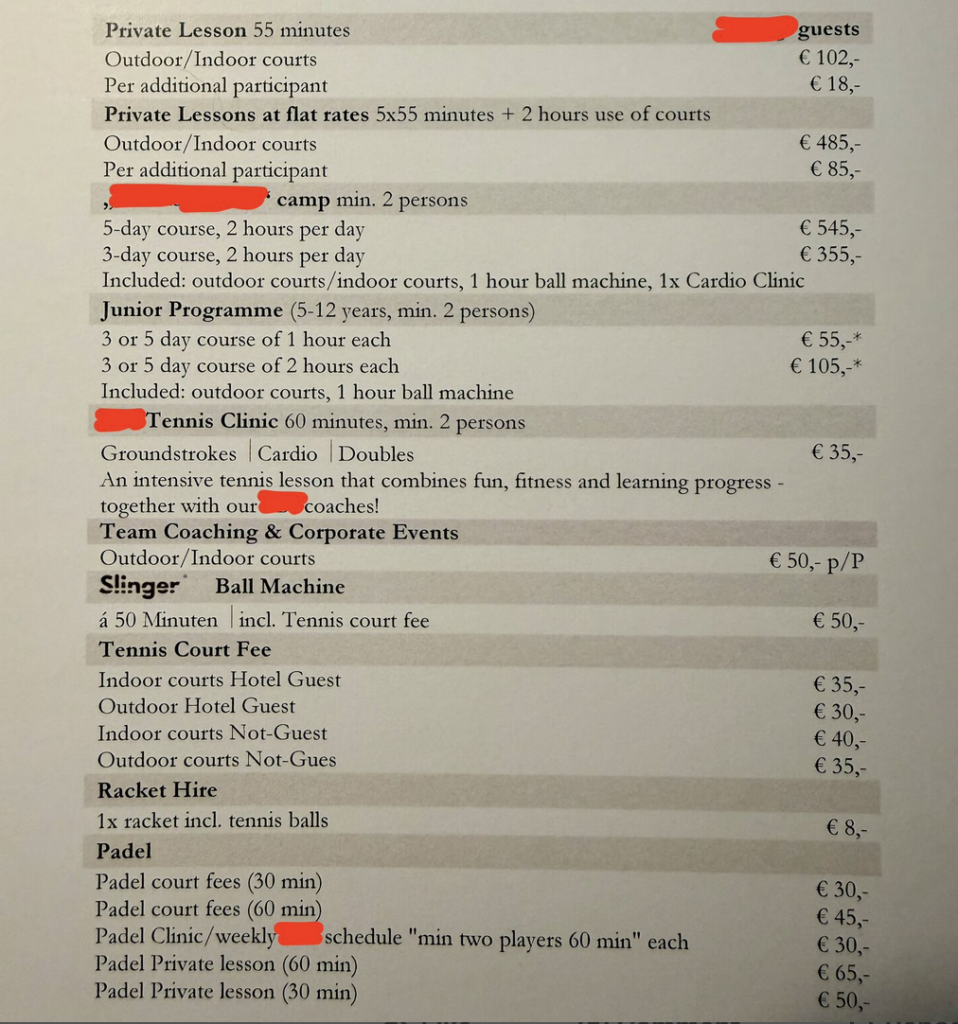
I recently came across this European 5-star resort’s tennis menu list and several things jumped out at me higher than a new can of tennis balls.
For a start, the high private-lesson rate shows strong confidence in coach quality and guest demand. The wide range of products — lessons, camps, clinics, juniors, corporate events — reveals a mature programme built to serve different types of guests, not just holiday players. And the inclusion of padel, cardio, ball machines and junior structure signals a facility that’s keeping pace with modern rackets trends.
But the deeper I dived, the more the pricing architecture starts to reveal subtle tensions.
– Indoor and outdoor court fees sit almost side by side, a guest-friendly gesture but one that doesn’t reflect the real cost difference.
– Padel lessons are priced dramatically below tennis lessons — far more than the industry norm — inadvertently positioning the sport as inferior rather than as a premium growth opportunity.
– The ratio between private lessons and clinics is unusually large, making private sessions feel disproportionately expensive rather than clinics being great value.
– And the absence of non-hotel guest lesson prices hints either at a lack of strategy or an exclusivity policy not clearly communicated.
Individually, none of these choices are wrong. But collectively, they paint a picture: a strong, confident tennis programme with room to sharpen its commercial logic and elevate its premium positioning even further.
Because in luxury hospitality, pricing isn’t just economics. It’s storytelling. And here, the story is good — but it could be great.
(Originally published on LinkedIn)