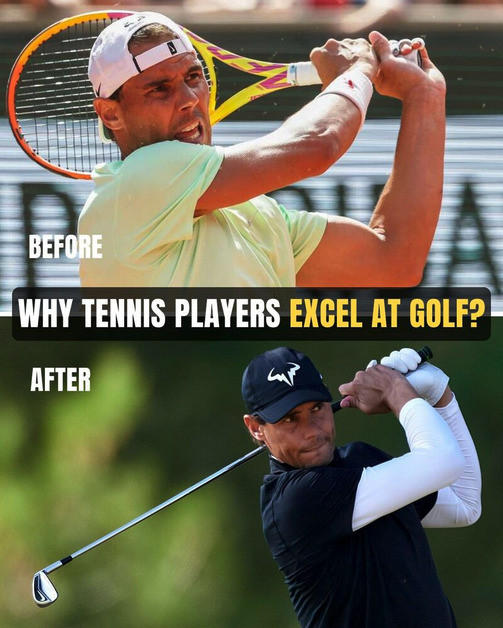
This image stopped me scrolling.
A before/after of Nadal’s tennis swing morphing into a golf swing — and it got me thinking about how much of a head start tennis players really have when they take up padel or pickleball.
At first glance, the crossover feels obvious. But when you unpack it, the advantages (and frictions) are more nuanced than we often admit.
Where tennis players clearly benefit
• Hand–eye coordination & anticipation: Years of reading spin, pace, height and body cues give tennis players a major perceptual edge. That translates directly to faster rally competence in both padel and pickleball.
• Footwork & spacing: Even on smaller courts, tennis-trained movement patterns — split steps, recovery angles, balance under pressure — shorten the learning curve, especially in padel transitions and pickleball kitchen positioning.
• Racket skills: Volleys, slices, topspin production and “feel” are transferable. Tennis players tend to reach tactical competence faster, even if their execution needs recalibration.
Where tennis can actually hold players back
• Over-hitting: Power that’s rewarded in tennis is often punished elsewhere. Pickleball, in particular, exposes players who struggle to soften hands and reset points.
• Net discipline: Padel walls and the pickleball NVZ challenge deeply ingrained tennis instincts. The court geometry demands patience and restraint rather than court domination.
• Mindset shift: Tennis players are conditioned to end points; padel and pickleball reward construction, tolerance and percentage play.
The participation data backs up this crossover dynamic. Roughly 30–40% of padel and pickleball players previously played tennis, yet around 65% of racket-sport participants now play multiple disciplines. That suggests skill migration is less about abandonment and more about portfolio behavior .
Are there sports with even stronger transfer effects?
Possibly. Squash players often adapt quickly to padel’s wall usage and spatial awareness. Table tennis players bring elite reflexes and touch that shine in pickleball. Even golf shares rotational sequencing, tempo control and sequencing principles — as this image neatly illustrates.
My personal take: tennis doesn’t just feed padel and pickleball — it creates adaptable racket athletes. The real opportunity isn’t debating which sport wins, but asking a better question:
How do clubs, coaches and federations design pathways where skills flow both ways — and players stay in the racket ecosystem longer?
Interested to hear where others see the biggest crossover advantages — and where tennis habits are hardest to unlearn.
(Originally published on LinkedIn)