The Facility Gold Rush: Why Padel & Pickleball Attract Private Capital… And Tennis Doesn’t….(for the moment)
If you want to understand where private capital is flowing in racket sports, don’t look at trophies or TV ratings—look at square metres and cash flow.
In my work with investors, developers and operators, one thing has become clear over the last few years:
padel and pickleball aren’t being funded because they’re trendy — they’re being funded because the unit economics work.
The numbers from the CAA Portas – “Racket Sports Race” report explain why .
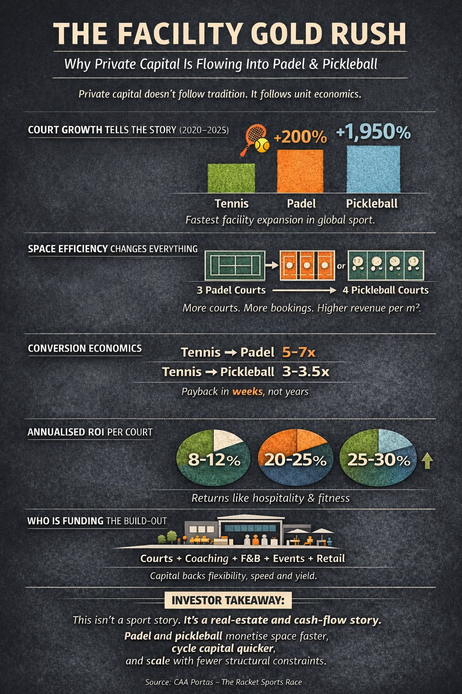
1. Facility growth tells you where money is going
Since 2020:
Tennis courts: +21% globally
Padel courts: +200%
Pickleball courts: +1,950%
This isn’t organic club expansion. This is capital responding to demand faster than the public sector can.
2. Lower CAPEX, higher efficiency
Compared to tennis, both sports benefit from:
Smaller court footprints
Lower construction costs
Faster build times
But the real driver is density.
One tennis court can be converted into:
3 padel courts
4 pickleball courts
For investors, that immediately changes revenue per square metre.
3. Conversions unlock step-change returns
The report highlights a reality I see frequently in feasibility models:
Converting a tennis court to padel increases daily revenue by ~5–7×
Converting to pickleball increases revenue by ~3–3.5×
Typical payback periods can be measured in weeks in some ideal scenarios, not years, assuming stable utilisation
This is why conversions are accelerating in mature markets like Spain and the US, even where tennis participation remains strong.
4. ROI profiles favour private capital
Estimated annualised ROI per court:
Tennis: ~8–12%
Padel: ~20–25%
Pickleball: ~25–30%
Unsurprisingly, around 70% of padel courts and ~50% of pickleball courts are now privately funded, while tennis remains predominantly public-sector driven.
5. Facilities are the commercial engine
Unlike tennis, where media and elite events dominate value creation, facilities represent ~50% of the total market value for padel and pickleball.
Hybrid venues — courts plus F&B, coaching, events and retail — are where investors are underwriting scalable returns.
The investor takeaway
This is not a story about one sport replacing another.
It’s about capital migrating toward formats that monetise space more efficiently, cycle cash faster, and scale with fewer dependencies.
Tennis remains culturally and globally powerful.
But from a pure infrastructure and real-estate perspective, padel and pickleball currently offer something investors find very hard to ignore.
(Originally published on LinkedIn)