Children don’t need sport nearly as much as adults do.
I know that’s not what we’re supposed to say.
We spend enormous amounts of time, money and energy trying to get children onto tennis courts, football pitches and basketball courts. Meanwhile, millions of adults drift away from sport altogether.
Yet the older I get, the more convinced I become that we’ve got the equation backwards.
Children already have many of the things that sport provides.
They have friends.
They have structure.
They have routine.
They have daily activity.
They have opportunities to play.
Sport undoubtedly helps develop confidence, resilience and teamwork. But most children already have multiple sources of social interaction and movement built into their lives.
Adults are different.
Somewhere between our twenties and fifties, many of us gradually lose the very things that make us healthy: Movement becomes optional, Friendships become harder to maintain, Work replaces play, Challenge becomes professional rather than personal. Entire weeks pass without doing anything simply because it’s enjoyable.
I’ve spent most of my life around tennis and other racket sports, and one thing has become increasingly obvious to me. The healthiest older players are rarely the ones obsessing over supplements, longevity hacks or the latest wellness trend.
They’re the ones who still have a regular doubles game every Tuesday, who still compete, laugh… and belong somewhere.
The popular narrative is that sport helps us live longer because it keeps us physically fit. That’s certainly part of the story. But I suspect the bigger benefit is social.
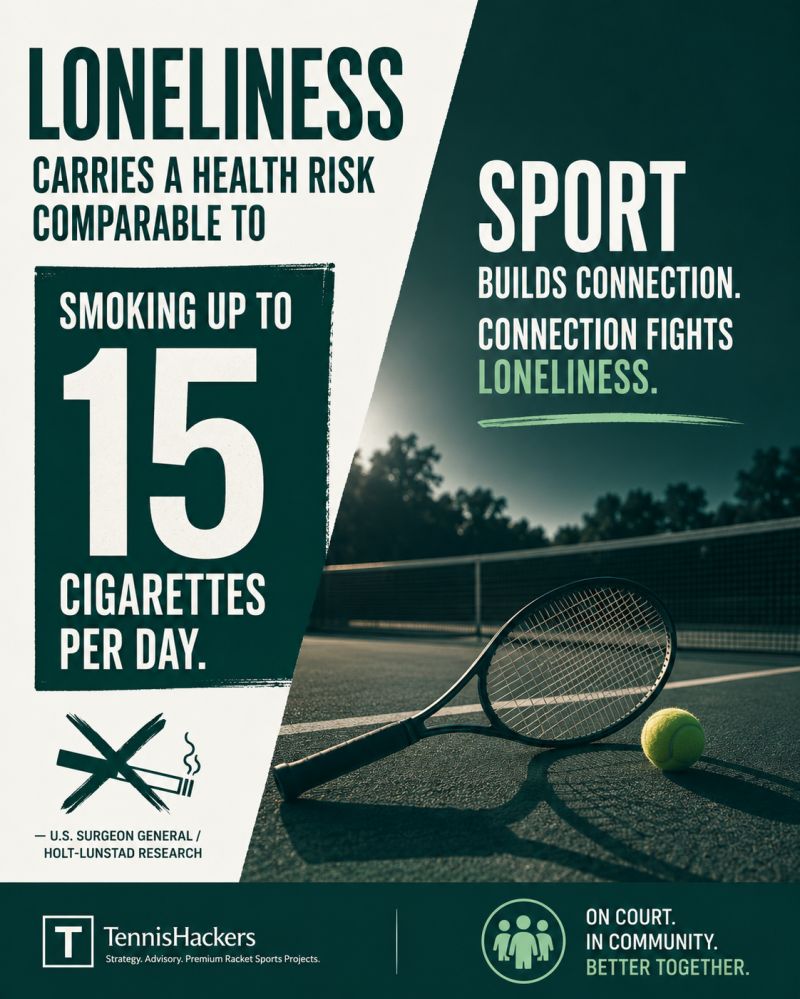
A landmark meta-analysis by Julianne Holt-Lunstad, covering more than 300,000 participants, found that people with strong social relationships had a 50% higher likelihood of survival than those with weaker social connections. Separately, the @U.S. Surgeon General has highlighted that the health impact of chronic loneliness can be comparable to smoking up to 15 cigarettes per day.
Think about that for a moment.
We often talk about exercise as medicine.
Perhaps community is medicine too.
And sport delivers both at the same time.
Many of the older tennis players I know aren’t showing up primarily for the tennis anymore. They’re showing up because it gives shape to their week. It gets them moving. It keeps them connected. It gives them a challenge, a routine and a reason to leave the house.
The mental health crisis isn’t primarily among 12-year-olds playing tennis.
It’s among the 45-year-olds who stopped.
Maybe the question isn’t how we get more children into sport… maybe instead it’s how we stop adults from leaving it.
(Originally published on LinkedIn)