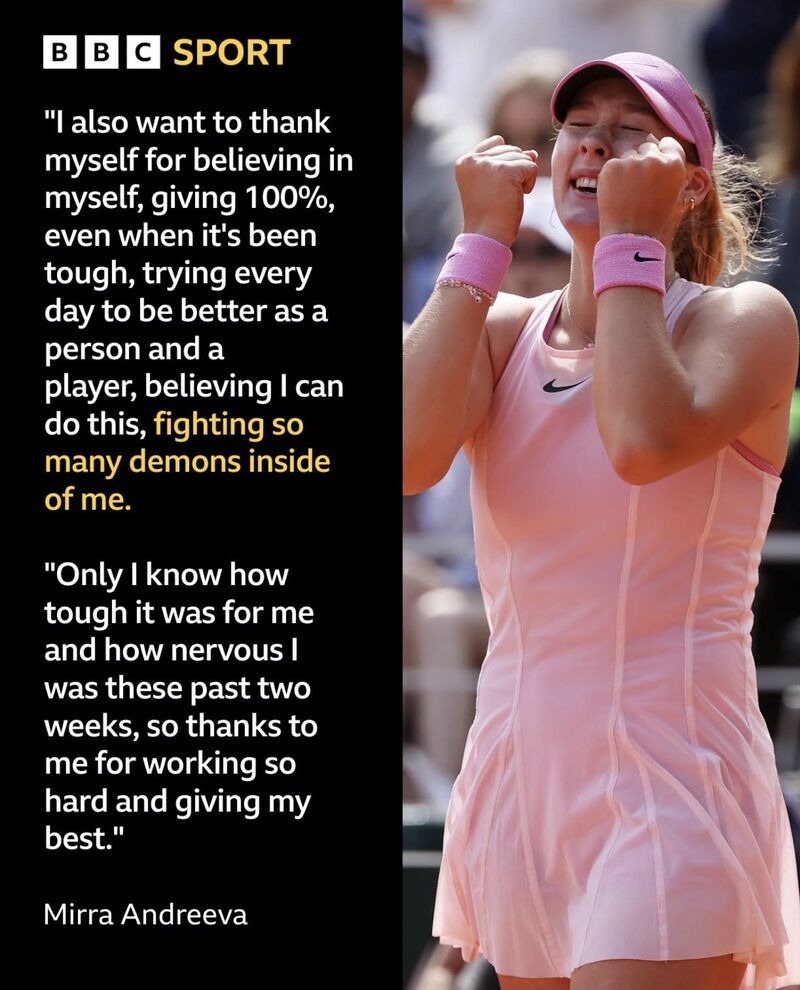
Thanking yourself sounds arrogant… until you understand what Mirra Andreeva was actually thanking herself for.
When we first heard Mirra Andreeva’s acceptance speech after winning the 2026 French Open, it could easily have triggered mixed feelings.
“I want to thank myself.”
Really?
No athlete reaches the top alone. Behind every champion stands a small army: parents, coaches, physios, hitting partners, sponsors, friends and countless people whose names never make the headlines. Success is almost always a team effort.
But the more you think about it, the more you realize Andreeva wasn’t thanking herself for winning.
She was thanking herself for enduring.
There is a difference.
She spoke about “fighting so many demons inside of me,” about the nerves, the pressure, the doubt and the daily effort required to keep going. Those battles happen in private. Coaches can guide you. Family can support you. Friends can encourage you. But nobody can do that work for you.
Psychologists often refer to this as self-efficacy: the belief that you can overcome challenges through your own actions. Research by psychologist Albert Bandura found that higher levels of self-efficacy are strongly linked to greater resilience, performance and persistence under pressure. In simple terms, people who believe they can handle adversity are more likely to do exactly that.
Another statistic that caught my attention comes from Gallup research showing that employees who receive recognition are significantly more engaged and productive than those who do not. Yet many of us wait for recognition to come from somebody else.
Why?
If we celebrate teammates, colleagues, employees and friends when they do something difficult, why are we often uncomfortable acknowledging our own effort?
I see this frequently in sport. Athletes will obsess over mistakes for weeks but brush aside achievements in seconds. They’ll analyse every missed forehand and forget the hundreds of hours of work that made them competitive in the first place.
That mindset isn’t humility. Sometimes it’s simply a lack of balance.
The lesson from Andreeva’s speech isn’t that we should become self-obsessed. It’s that we should become better at recognising our own contribution….not because we did everything ourselves, but because there are certain battles that only we can fight.
The next time you overcome a difficult period, launch a project, survive a setback or simply keep showing up when it would have been easier to quit, take a moment to acknowledge it.
You don’t need a trophy ceremony.
You don’t need applause.
You just need the honesty to admit that you did something worth being proud of.
And perhaps, every now and then, to thank yourself for it. Its something most of us probably don’t do enough.
And, if nothing else, giving yourself a pat on the back is good exercise for your arm.
(Originally published on LinkedIn)