A sport doesn’t become global by hiding indoors.
Every truly global participation sport is played outdoors….Football. Tennis. Cricket. Basketball. Running. Cycling.
Yet when I speak to investors and operators in padel, there seems to be an assumption that the sport’s future lies under a roof.
That’s a mistake.
Admitedly, indoor facilities maximise utilisation, reduce weather risk, and create more predictable revenue streams. If you’re investing millions into a facility, those factors matter.
But sometimes I wonder whether the industry has become so focused on optimising the business model that it is overlooking one of the biggest drivers of participation: visibility.
I grew up in the UK, where we played tennis outdoors almost year-round. Rain stopped us. Not much else did. Wind was a constant challenge and I even remember once playing through a snow storm. We were keen and we just got on with it.
The idea that people in Northern Europe won’t play racket sports outdoors has always felt slightly strange to me because millions of tennis players have been doing exactly that for generations.
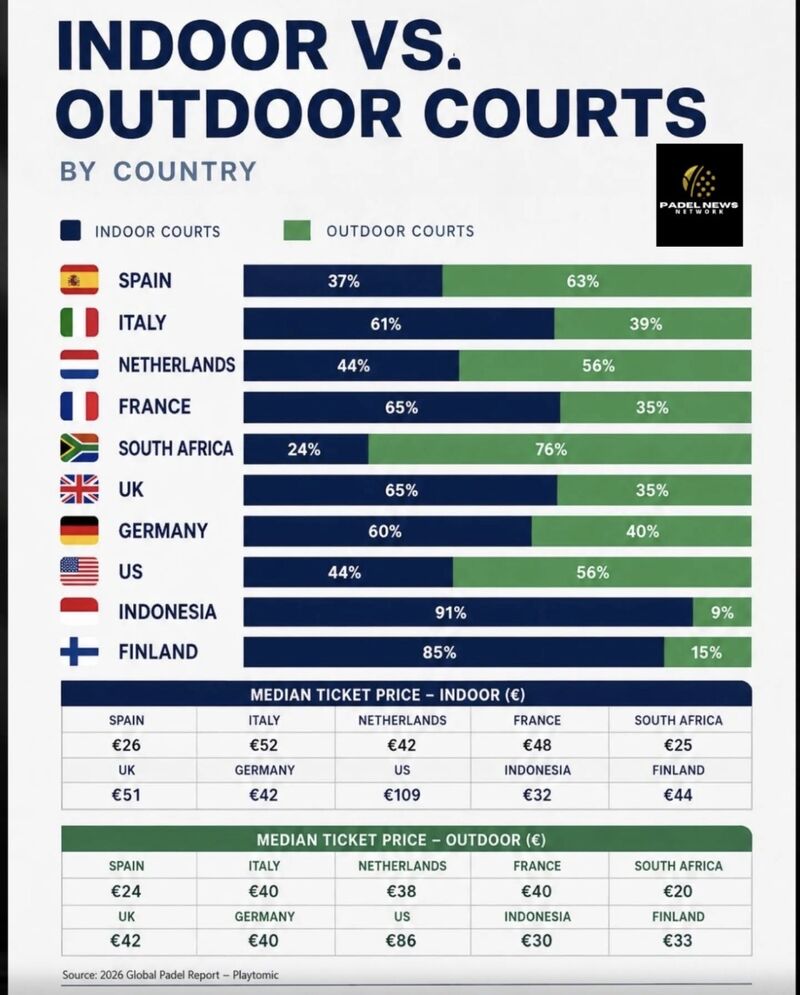
Looking at recent PLAYTOMIC data, some interesting patterns emerge. Spain, the world’s most established padel market, still has 63% of its courts outdoors. The Netherlands, despite its climate, has 56% outdoor courts. Even in the United States, 56% of courts are outdoors.
That doesn’t look like a sport desperately trying to escape the elements.
It looks like a sport that people are perfectly happy playing outside.
The comparison with tennis is also difficult to ignore. According to estimates from the International Tennis Federation, roughly 90%+ of tennis courts globally are outdoor courts. Tennis didn’t become one of the world’s largest participation sports by hiding itself away in warehouses and industrial estates.
People discovered tennis because they saw it.
The same principle applies to padel.
An outdoor court in a public park, sports club, resort, or residential community becomes a billboard for the sport. Thousands of people walk past it every week. Some stop and watch. A few decide to try it. That’s how participation ecosystems grow.
Indoor facilities may well be the superior operating model.
But I’m not convinced they’re always the superior growth model.
If padel genuinely wants to become a mainstream global sport rather than simply a successful facility business, it needs to remain visible. And visibility is much easier to achieve when the sport is played where people actually are.
I suspect – or at least I hope – outdoor courts will play a much bigger role in padel’s long-term growth than many people in the industry currently beleive.
Sources: Playtomic Global Padel Report 2026; International Tennis Federation court estimates, Padel News Network
(Originally published on LinkedIn)