Can Pickleball and Padel Join the club?
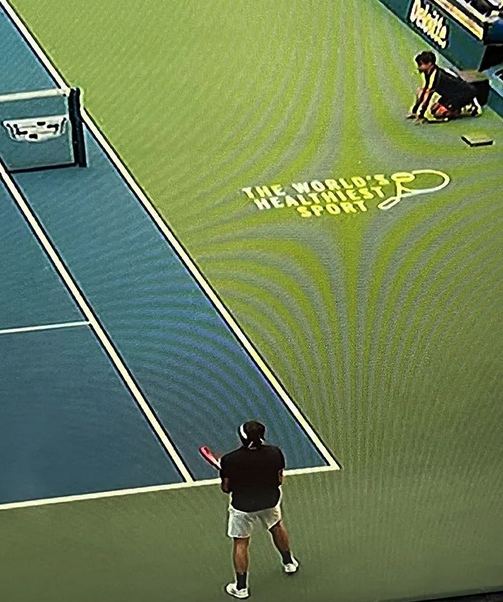
I loved how the USTA loudly proclaimed “THE WORLD’S HEALTHIEST SPORT” on-court during the recent US Open.
It’s not just marketing spin — there’s real evidence behind it.
A landmark study published in the British Journal of Sports Medicine in 2016 found that tennis players have a 47% lower risk of all-cause mortality compared to non-players, with even stronger results for cardiovascular health. The social interaction, aerobic demands, coordination, and mental engagement make tennis uniquely beneficial for both body and mind.
Other studies have shown that playing tennis regularly can add up to 9.7 years of life expectancy, surpassing sports like cycling, swimming, and running. The combination of physical exertion, strategy, and social connection makes it a “complete sport” in the truest sense.
But here’s the question: can pickleball and padel also claim to be “the world’s healthiest sports”?
Both are booming globally, attracting millions of new players thanks to their accessibility and community feel. Yet, their smaller court dimensions and frequent doubles format naturally mean less distance covered, fewer high-intensity bursts, and a lower overall physical load compared to tennis.
That’s not necessarily a drawback — it’s a different kind of value proposition. Pickleball and padel may not match tennis in aerobic intensity, but they excel in inclusivity, social interaction, and adherence — key predictors of long-term physical activity.
Perhaps the future of racquet sports marketing lies not in competition, but in collective positioning:
Tennis as the ultimate full-body challenge.
Padel as the social, accessible hybrid.
Pickleball as the entry point to lifelong movement.
The “World’s Healthiest Sport” may have started as a USTA campaign — but it’s an idea that can inspire an entire category.
(Originally published on LinkedIn)