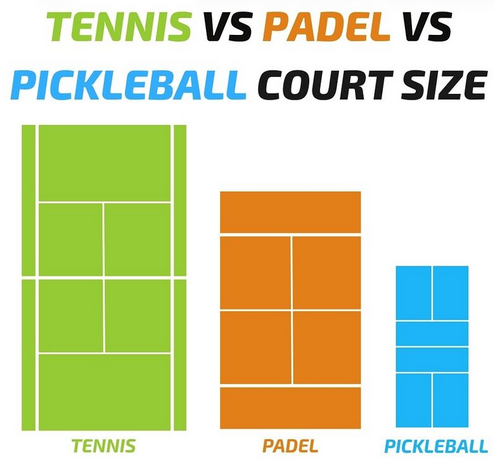
In the sports industry, we often talk about participation trends, community engagement, and player experience. But one factor that is frequently overlooked is the economics of space. Court size directly influences revenue potential, utilization rates, and long-term sustainability for clubs and investors.
A standard tennis court occupies significantly more space than either padel or pickleball. That means the same footprint that accommodates one tennis court can often be reconfigured to host two padel courts—or even three to four pickleball courts—depending on layout and safety margins. This density shift has real financial implications.
Consider Spain, where padel has exploded in popularity. Many traditional tennis clubs have converted underutilized courts into padel facilities, doubling their booking capacity and attracting a younger, more diverse audience. The result has been higher membership retention and new revenue streams from lessons, leagues, and social play.
In the United States, pickleball has followed a similar trajectory. Municipalities and private operators have found that converting a single tennis court into multiple pickleball courts not only increases participation but also maximizes hourly revenue. In some cases, facilities report that pickleball courts generate two to three times the bookings per square foot compared to tennis.
The lesson is clear: court size is not just a design consideration—it is a revenue strategy. Operators who understand the spatial economics of racket sports are better positioned to capture growth, diversify their offerings, and future-proof their facilities.
(Originally published on LinkedIn)