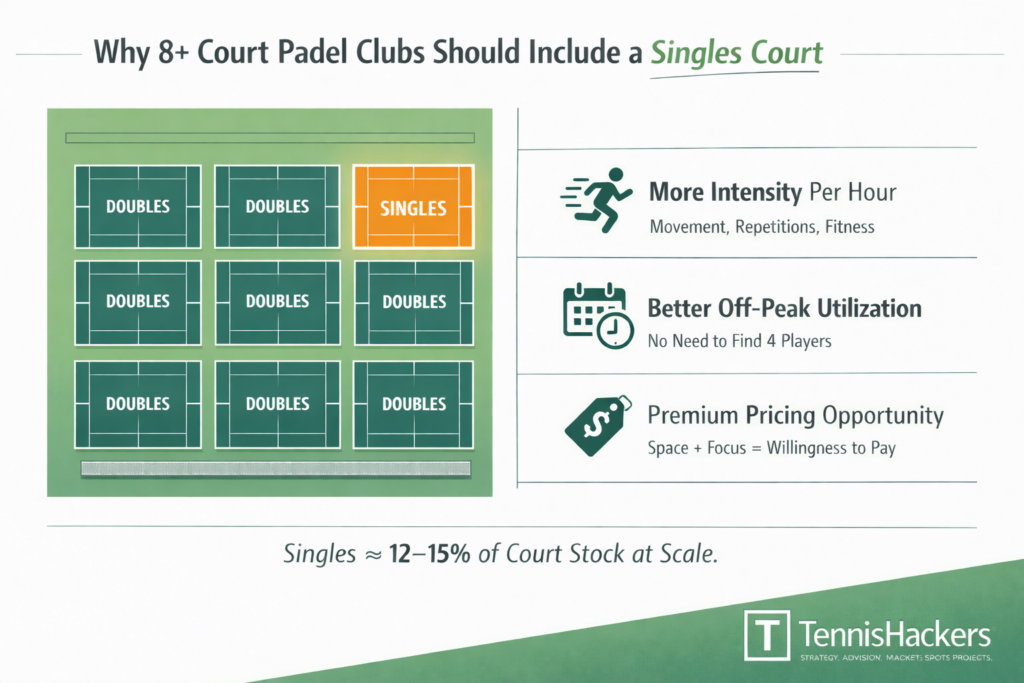
Every padel facility with 8 or more courts should include at least one singles court.
I say this as someone who genuinely enjoys doubles padel. It’s social, fun, and it’s what most of us were introduced to first. But if I’m being honest, I prefer playing singles. More movement. More balls hit. More intensity. And, quite simply, more bang for my money in a one-hour slot.
That personal preference is what got me thinking more seriously about how facilities are designed—and what they unintentionally encourage.
Once a padel club reaches a certain scale, it stops being just a collection of courts and starts functioning as a small ecosystem. In my view, that inflection point is around 8 courts. Below that, every court needs to be optimized for peak-hour demand and social play. Above it, something changes: the club begins shaping player behaviour rather than just responding to it.
At that scale, the absence of a singles court starts to show. Doubles is padel’s superpower, but it doesn’t suit every moment, every player, or every time slot. Some players want focused training. Some want physical intensity. Some are improving and want more repetitions per session. Others simply don’t want to depend on finding three other people every time they play.
A single singles court—roughly 12–15% of total court stock in an 8-court facility—is not a threat to utilisation. In practice, it often smooths it. Singles courts work exceptionally well for coaching, drills, and individual sessions. They are easier to fill during off-peak hours, when many players struggle to get four people together but would happily play one-on-one.
There’s also a retention angle that’s easy to miss. As players improve, some begin to crave more touches, more movement, and more control over the rally. If a club only offers doubles, those players often train elsewhere—or may drift back to tennis—without anyone quite noticing why.
Singles courts plug gaps on so many levels.
Then there’s pricing. This is important: don’t cheap it out. Players who choose singles are typically willing to pay a premium. They’re paying for space, intensity, and a less crowded court. Priced correctly, a singles court doesn’t undermine revenue per hour—it often matches or exceeds it on a per-player basis, especially when paired with coaching or performance-focused sessions.
More broadly, including a singles court sends a signal. It says the club supports progression as well as participation. That it caters not just to social demand, but to how players evolve over time.
Padel’s growth has been extraordinary in recent years across Europe and beyond. But growth at scale brings new responsibilities. Facilities don’t just host the sport; they shape what kind of sport it becomes.
A singles court isn’t a luxury. It’s a small, strategic addition that makes the ecosystem more complete.
(Originally published on LinkedIn)