If every tournament in Europe disappeared tomorrow, would padel collapse?
A recent comment from Andrew Nicholson to one of my posts — “infrastructure builds the sport, player development sustains it” — made me think hard about that.
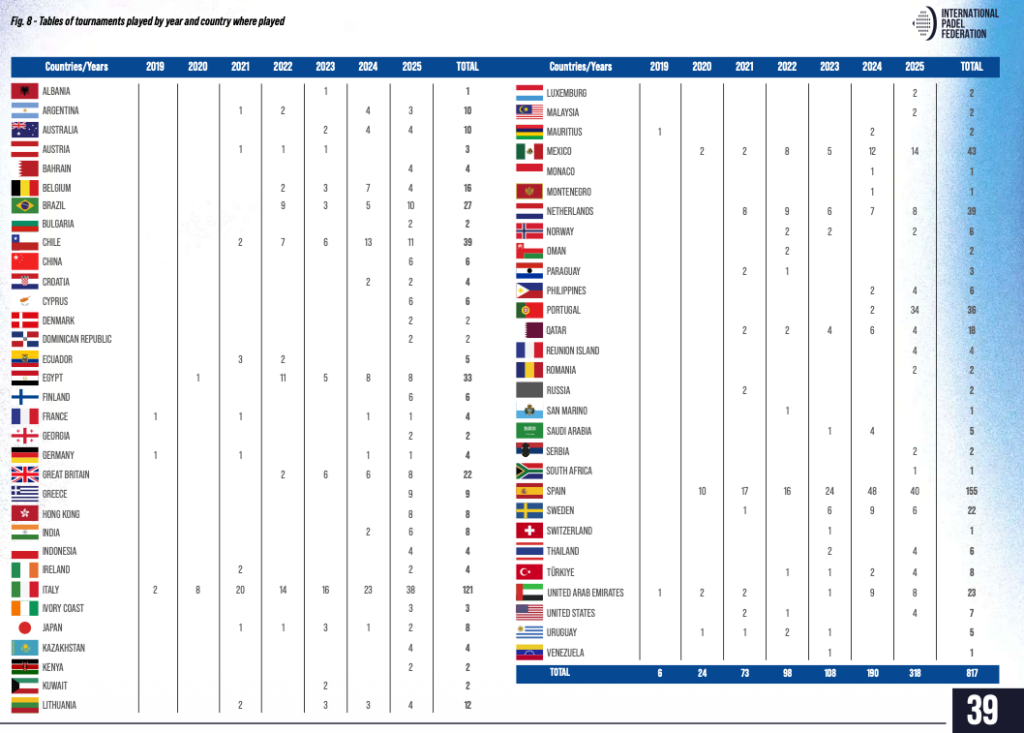
Looking at the latest IPF data (2019–2025), the most mature padel markets host the most tournaments:
• Spain – 155
• Italy – 121
• Netherlands – 39
• Portugal – 36
At first glance, it’s tempting to conclude: more tournaments leads to stronger market.
I’m not convinced. In my experience as a former coach working inside clubs, tournaments are not what sustain a sport. They are what express a mature one.
Most participation sports operate on a pyramid model:
• 80–90% recreational players
• 8–15% competitive amateurs
• 1–2% performance athletes
This dynamic isn’t unique to padel. In Britain, the LTA reports over 5 million annual tennis players, yet only a small fraction compete regularly, and Sport England data shows most club-sport participants are recreational. Golf mirrors this reality: 75–85% of club revenue comes from social members, not tournament players or elite pathways.
Facilities are not financed by performance players. They are financed by:
• Weekly court bookings
• Social leagues
• Adult beginners
• Corporate events
• Parents paying for junior sessions
That is the economic engine. From what I see daily, clubs don’t build courts because tournaments exist. They build courts because waiting lists exist.
When density reaches a critical mass, a small percentage of players want something more structured, more competitive. That demand then produces tournaments.
So when we see Spain hosting 155 IPF events, I don’t see a country built by tournaments. I see a country with extraordinary player density — where a minority segment is large enough to sustain frequent competition.
Tournaments, in that sense, are a by-product of maturity, not the cause of it.
Andrew’s comment is partly right. Infrastructure absolutely builds the sport. Player development sustains the top of the pyramid — national teams, visibility, media relevance.
But recreational participation sustains the entire ecosystem. Without hobby players, there is no stable club revenue, no sponsor attractiveness, no coaching jobs, no federation funding base, no long-term pathway.
We sometimes overestimate the impact of elite structures because they are visible. Finals are visible. Rankings are visible. Pro pathways are visible. Whilst the Tuesday night social leagues are not. Yet those Tuesday night players are the ones keeping the lights on.
If federations in emerging markets focus primarily on tournaments and performance pathways without first building participation density, it’s like building a ceiling before building a floor.
The IPF table doesn’t show that tournaments create mature markets.
It shows that mature markets create tournaments.
(Originally published on LinkedIn)