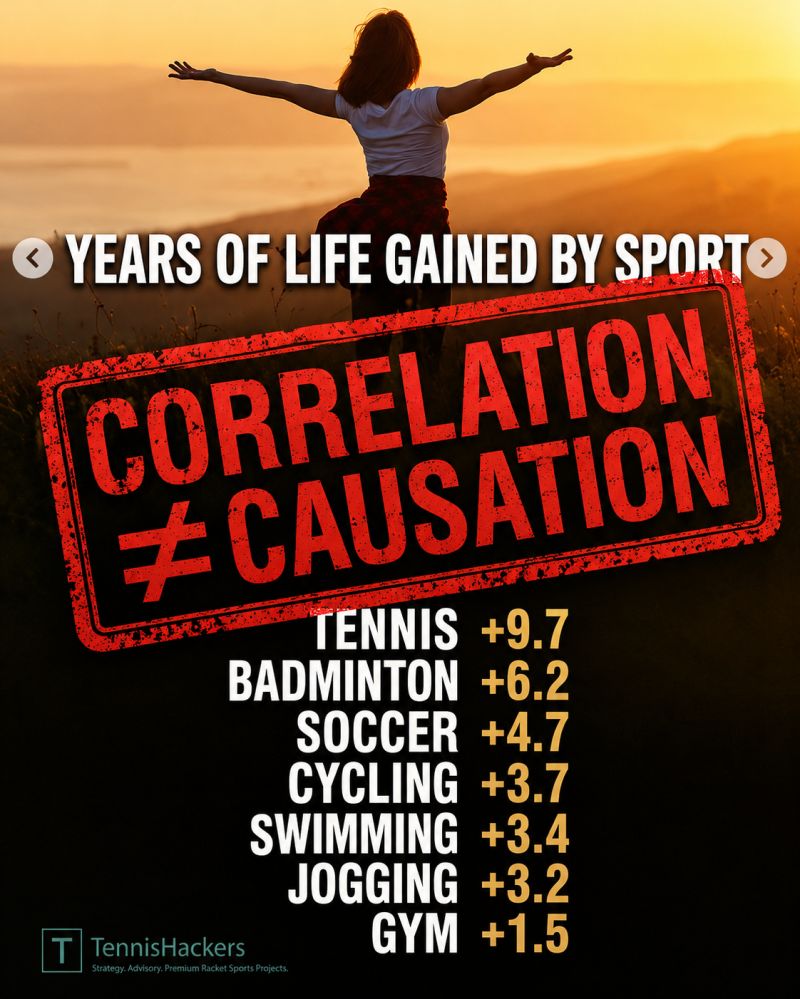
EVERYONE KEEPS ASKING WHAT THE HEALTHIEST SPORT IS.
I think that’s the wrong question.
We’re obsessed with calories burned, heart rates and VO₂ max.
As if the “best” sport is simply the one that punishes your body the most.
I don’t buy it and think we’ve misunderstood what makes a sport truly healthy.
It isn’t intensity, neither is it sustainability.
WE’VE CONFUSED FITNESS WITH HEALTH
Running burns calories, CrossFit builds strength, Cycling develops endurance.
Fantastic. And yet millions of people quit them every year. Why? Because the healthiest workouts aren’t the ones that are physiologically perfect.
It’s the ones you’re still doing twenty years from now, built over decades of effortless commitment and fun.
And that’s where tennis—and perhaps racket sports more broadly—becomes incredibly interesting.
THE COPENHAGEN STUDY ISN’T THE STORY
Every few weeks someone shares the famous statistic:
“Tennis adds 9.7 years to your life.”
It comes from the Copenhagen City Heart Study, which found tennis players had the greatest longevity advantage among the sports studied.
But I think everyone focuses on the wrong number.
The 9.7 years isn’t what fascinates me.
The question is… Why?
Is it the cardio? The explosive movement? The decision-making?
Or could it simply be that tennis is one of the few sports people willingly play from the age of six until their eighties?
That’s a completely different conversation.
MAYBE THE SECRET ISN’T THE SPORT
I’ve witnessed the best tennis clubs operate almost like miniature communities.
People don’t just come to exercise. They meet training partners, play doubles, coach juniors, volunteer, stay for coffee.
And, most importantly, they keep coming back. Not because they have to but because they want to. It’s an unforced fitness regimen that requires no self-discipline
Across Europe, tennis participation has recovered strongly to 23.6 million players, supported by almost 126,000 coaches. That’s more than participation growth—it suggests remarkable long-term engagement with the sport.
Perhaps we’re attributing the health benefits to the racket…
when the real advantage is belonging to something for decades.
SO WHAT MAKES A SPORT “HEALTHY”?
Maybe we’ve been measuring the wrong things all along.
Instead of asking: “Which sport burns the most calories?”
Perhaps we should ask:
Which sport can I still enjoy at 75?
Which sport keeps challenging my brain?
Which sport gives me a reason to leave the house?
Which sport helps me build relationships that last longer than a season?
If a sport improves your body and gives you a community you’ll still be part of thirty years later… that’s probably healthier than any fitness metric can measure.
I’d argue we’ve spent years ranking sports by physiology.
The next generation should rank them by how well they fit into a lifetime.
What do you think belongs at the top of that list?
(Originally published on LinkedIn)