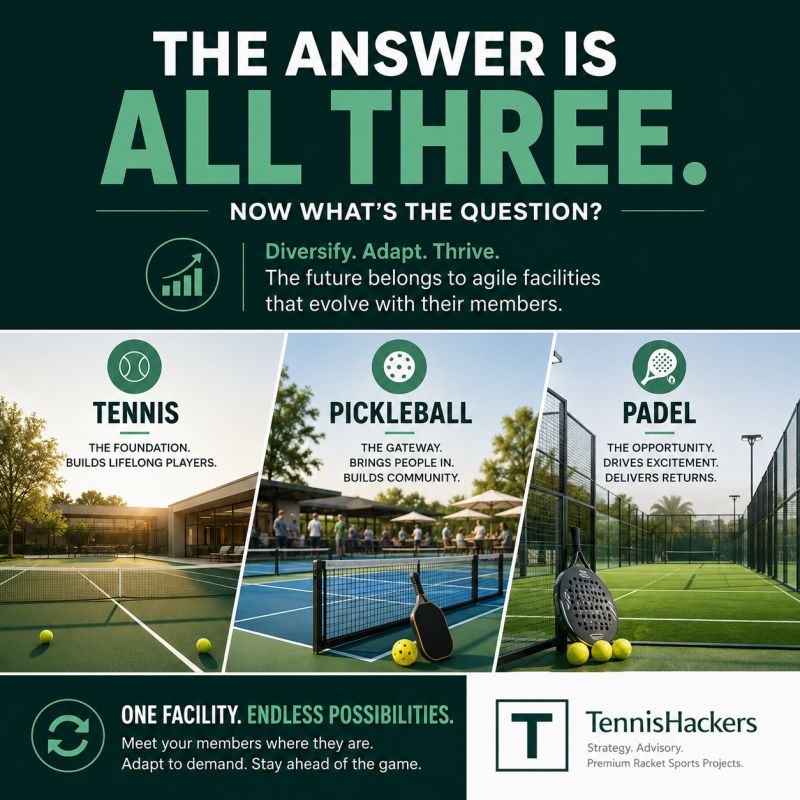
“The answer is all three. Now what’s the question?”
I wrote this last week after reading Scott Mculloch’s excellent article on why successful racket facilities of the future will integrate tennis, pickleball and padel.
Let me expand a little on that with some additional perspectives and analogies.
DIVERSIFICATION
If you invested your entire retirement fund into a single stock, most financial advisors would call that reckless.
So why do clubs do exactly that with racket sports?
During Sweden’s padel boom, many operators went all in. Tennis courts disappeared, new padel facilities opened almost overnight and, for a while, it worked brilliantly.
Then the market matured.
Participation stabilised, competition intensified, supply overtook demand and many facilities were left with more courts than they could fill. Some closed. Others are now being converted back to other uses.
The lesson isn’t that padel was a mistake, it is that building your business around one booming sport is risky.
THE PORTFOLIO
That’s why I believe the future belongs to facilities that embrace tennis AND pickleball AND padel.
Think of them as three investments in the same portfolio.
Tennis remains the foundation, with the strongest coaching ecosystem and long-term player retention.
Pickleball attracts newcomers and builds highly engaged communities.
Padel continues to generate excitement and strong commercial returns in many markets.
Each sport has its cycle. Diversification allows you to benefit from all of them.
FLEXIBILITY
The biggest advantage isn’t simply offering more choice.
It’s having the flexibility to adapt as demand changes.
If one sport accelerates, you can respond. If another slows, you can rebalance. Converting courts isn’t free, but it’s far less painful than discovering your entire business is built around yesterday’s boom.
Agility is becoming one of the most valuable assets a racket facility can have.
TRADITION
Even the world’s most traditional clubs understand this.
Queen’s Club in London—one of tennis’s great institutions—has installed padel courts. Not because tennis is declining, but because member expectations evolve, and successful clubs evolve with them.
THE REALITY
I know this won’t be universally popular.
There are respected voices in our industry, such as Mike Barrell, who believe tennis alone is enough. For some clubs, they’re probably right.
But most facilities are competing for members’ leisure time. If your members have to leave your club to play another racket sport, you’re creating an opportunity for a competitor.
THE BIGGER PICTURE
The issue isn’t whether tennis, pickleball or padel wins. The real winners will be the facilities agile enough to adapt as the market changes.
In business, just as in investing, diversification rarely delivers the biggest short-term return. But over the long term, it’s usually the strategy that wins.
(Originally published on LinkedIn)