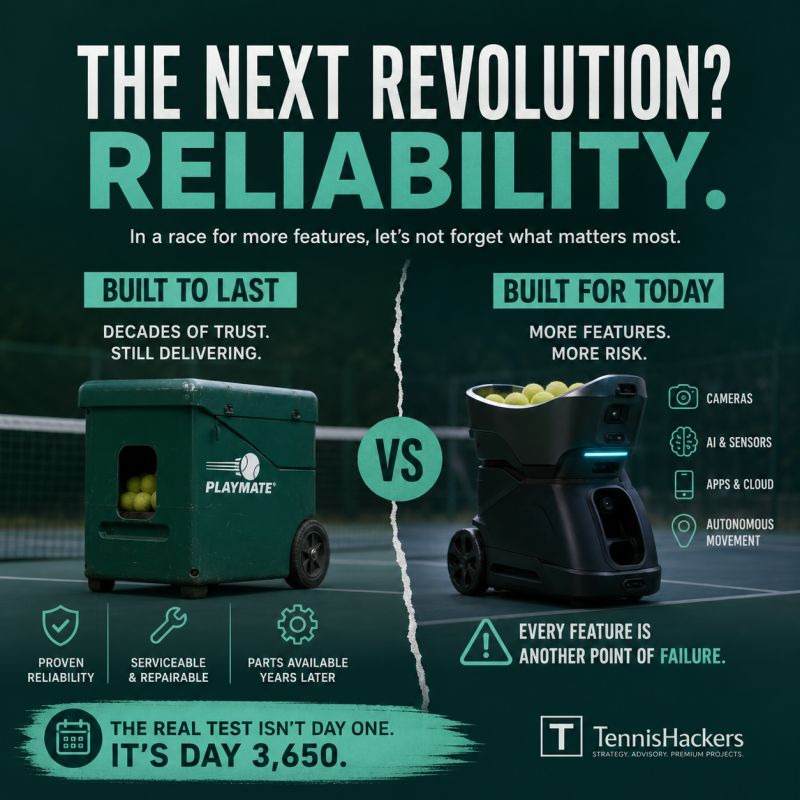
Buying a tennis ball machine has become a gamble. It shouldn’t be.
Every year, another company claims it have built the future of tennis training: Smarter AI. Better cameras. More realistic drills. A slicker app.
And every year, our industry gets excited all over again.
Maybe it’s time we became a little more sceptical.
After so many years in the rackets industry, I’ve witnessed countless manufacturers arrive with bold promises, impressive demonstrations and plenty of investor enthusiasm. Some genuinely pushed the industry forward. Others quietly disappeared before many customers had even finished paying off their machines.
Remember Silent Partner? Shotmaker? Several regional manufacturers that never quite reached critical mass? More recently we’ve seen the rise of Slinger, Tennibot, Nisplay Sports, PONGBOT and a growing wave of AI-powered entrants, all convinced they’ve found the formula that will redefine practice.
Some will… and many won’t. That’s not pessimism…that’s simply how innovation works.
What surprises me is how little attention buyers (and manufacturers) pay to a question that should arguably come first:
Who will still be supporting this machine ten years from now?
Because when you invest in a ball machine, you’re not buying a gadget…you’re buying into a company. That includes:
· Its supply chain.
· Its customer service.
· Its software.
· Its spare parts.
· Its financial stability.
· Its ability to survive.
The most innovative feature in the world means very little if a replacement battery, motor or control board can’t be sourced three years later.
I know this because I’m living it. My own Slinger Bag has been sitting unused for over a year because I haven’t been able to obtain a replacement battery.
It didn’t fail because the engineering was poor. It failed because the ecosystem around it broke down.
That experience completely changed how I assess sports technology.
The companies I admire most today aren’t necessarily those making the biggest marketing claims. They’re the ones quietly building trust year after year. Brands like Playmate, Lobster Sports, Inc. and Sports Tutor have spent decades proving that reliability isn’t boring—it’s a competitive advantage.
According to the European Tennis Report, Europe now has more than 25 million active tennis players, and participation continues to grow. That growth will attract even more investment, more startups and even more ambitious ideas.
That’s fantastic for our sport.
But innovation shouldn’t only be measured by what a machine can do on Day One….It should also be measured by whether it still works—and whether someone still answers the phone—on Day 3,650.
In technology, everyone wants to be first but in sport, I’d argue it’s often better to be the company that’s still standing.
(Originally published on LinkedIn)