Well done LIVING TENNIS LTD.
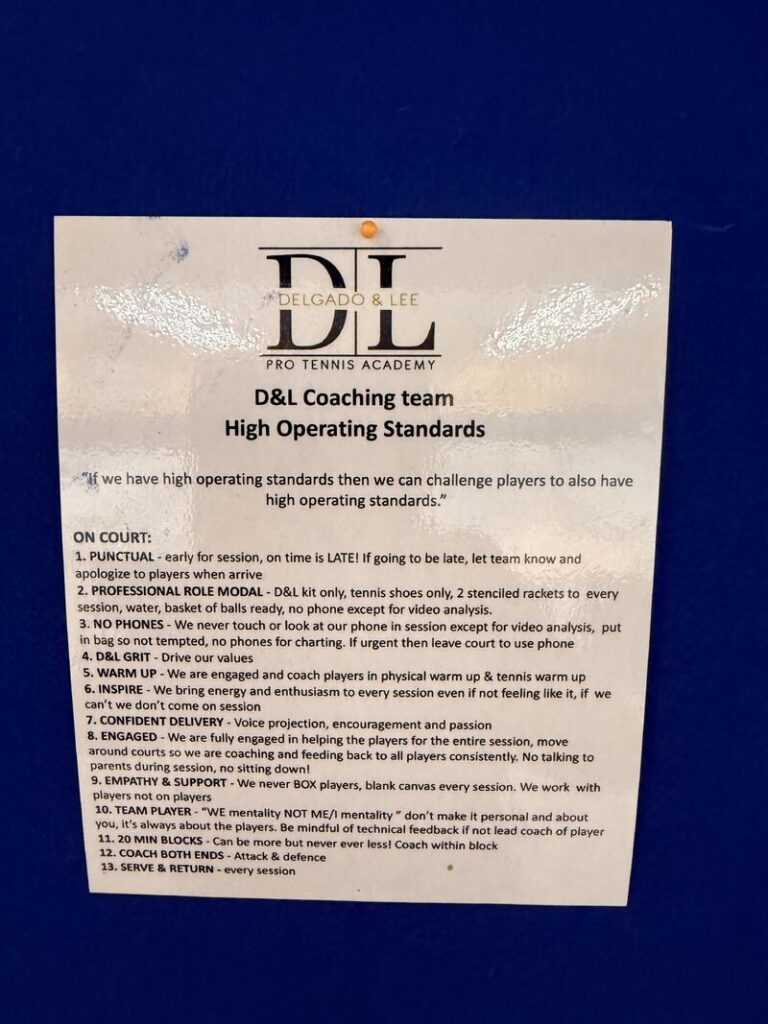
I took this photo at Bisham Abbey National Sports & Conferencing Centre in the UK this week because it stood out – certainly not because it is particularly beautiful.
But it may be one of the best examples of a tennis academy communicating its culture that I have seen in a long time.
VALUES NEED TO BECOME BEHAVIOURS
At the top it says:
“If we have high operating standards then we can challenge players to also have high operating standards.”
What follows isn’t the usual collection of corporate words like excellence, integrity and professionalism.
It tells coaches exactly what those things mean: Arrive early. Be prepared. No phones. Warm players up properly. Stay engaged for the entire session. Support other coaches. Show empathy. Coach both ends of the court. Serve and return every session.
I spent more than 25 years working in tennis academies and clubs, and one thing I learned is that culture rarely comes from what is written in a mission statement. It comes from what people repeatedly do when nobody is watching.
THE BORING STUFF MATTERS
This is what I particularly like about this board.
Some of the standards are almost painfully mundane, have the basket of balls ready, have your water, bring two stencilled rackets, be on time.
But that is exactly where standards are built.
Gallup’s research suggests that managers account for around 70% of the variance in team engagement. Their research also found that highly engaged teams can show a 23% difference in profitability compared with teams in the lowest engagement quartile.
Different industry. Different environment. But the principle is highly relevant to tennis.
CULTURE IS WHAT HAPPENS EVERY DAY
I’ve seen plenty of academies with great coaching philosophies that never quite translate into a consistently great experience.
The problem is usually not knowledge. It’s consistency.
You cannot ask players to be punctual when coaches regularly aren’t. You cannot demand concentration while someone is checking their phone. And you can’t ask players to have high standards if the people coaching them don’t demonstrate those standards themselves.
That is why I found this photograph so refreshing. It isn’t trying to sell anything. And it’s no more than a simple laminated sheet of paper pinned to a noticeboard outside the tennis courts.
But it is telling the people responsible for delivering the experience: this is what we expect from ourselves. And it tells all the students and parents what to expect. In full view, every day, for everyone to see.
That perhaps is the best test of an organisation’s values. Not what it puts on its website.
But what it pins to the wall and expects its people to do every day.
(Originally published on LinkedIn)