10 padel facts that might surprise even people in the industry:
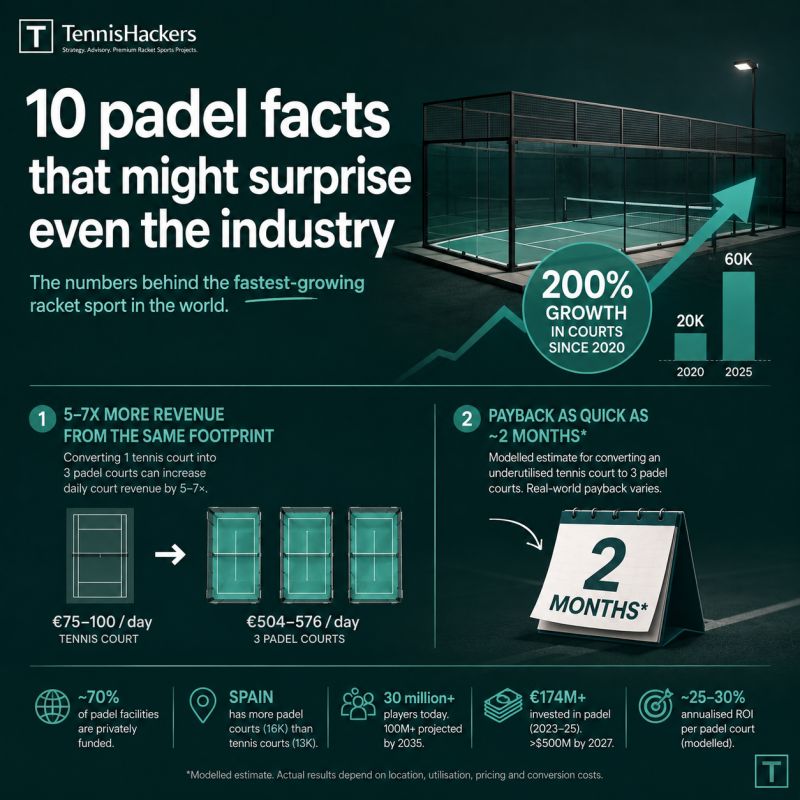
- Padel courts have grown 200% since 2020.
From roughly 20,000 to 60,000 courts globally in just five years. The bigger surprise? The forecast is for 140,000–190,000 courts by 2035. - Around 70% of padel facilities are privately funded.
For comparison, around 78% of tennis courts are publicly funded. Padel’s rapid expansion is therefore being driven by a very different capital model – one that allows it to be nimble and creative. - Building a padel club can require roughly 30% less CAPEX than building a tennis club.
That lower entry cost makes it easier for private operators to experiment, replicate successful concepts and scale quickly. - Converting one tennis court into three padel courts can increase daily court revenue by 5–7×.
The modelled numbers are roughly €75–100/day for tennis versus €504–576/day for three padel courts. Suddenly, the padel-versus-tennis debate looks less like a sporting argument and more like a real-estate one. - The estimated payback on that conversion can be just two months.
That’s the modelled figure for an underutilised tennis court. Obviously, real-world payback varies hugely by location, utilisation, pricing and conversion costs — but the economics explain why conversions are happening so aggressively. - Spain has more padel courts than tennis courts.
Approximately 16,000 padel courts versus 13,000 tennis courts. Padel isn’t simply competing for a share of the tennis market anymore. In its most mature market, it has already overtaken it in court numbers. - More than one in three new racket-sport facilities in the US now offer both padel and pickleball.
The emerging business model may therefore not be a “padel club” at all — but a multi-racket sports destination. - The padel club is becoming a hospitality business.
In the UAE, around 20% of clubs already have a coffee shop on-site. Increasingly, courts are being combined with F&B, fitness, retail, events and social spaces. The court becomes the anchor product, rather than the entire product. - More than €174m of private capital was invested in padel between 2023 and 2025.
And investment is expected to exceed $500m by 2027. Padel is moving from being a participation story to becoming an investable asset class. - The headline number may actually be 25–30%.
That’s the estimated annualised ROI per padel court in the model — compared with roughly 8–12% for tennis and 20–25% for pickleball. These aren’t guaranteed investor returns, but they tell you a lot about why capital is moving into padel.
The interesting story about padel isn’t simply how quickly people are taking it up but how quickly the economics around the sport are changing.
(Originally published on LinkedIn)