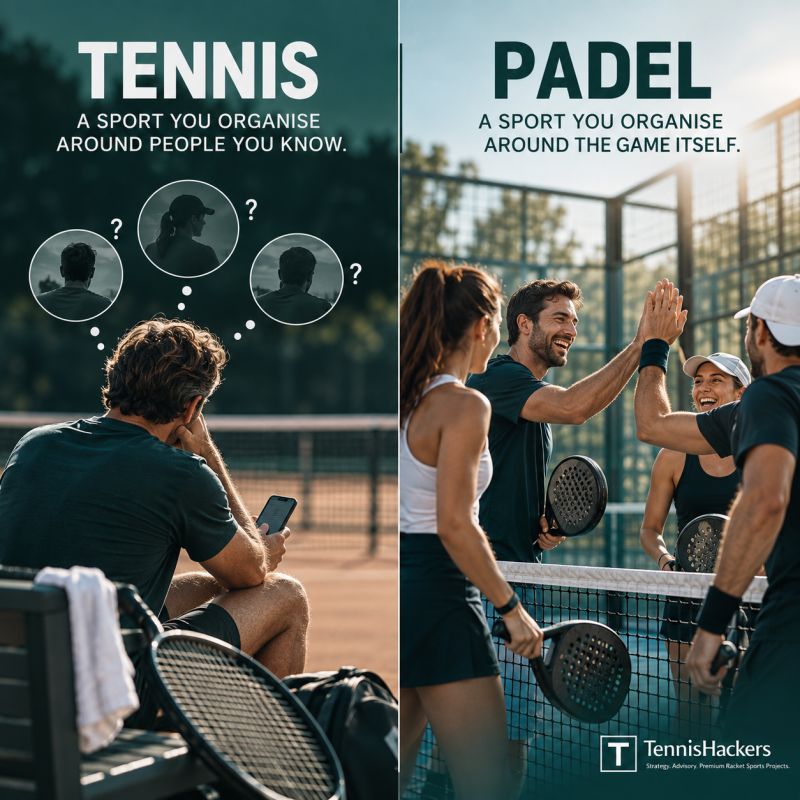
Why will a tennis player spend 20 minutes trying to find three people they know to play with, while a padel player will happily join three complete strangers?
I’ve been thinking about this after using PLAYTOMIC recently. I found plenty of open padel matches where you can simply join a game with people you’ve never met. In tennis, I found almost none.
Maybe I was using the wrong app. But after 25+ years around tennis clubs, resorts and players, I suspect there is something more fundamental going on.
THE TENNIS PROBLEM
Tennis is often organised around the people you already know.
“Who are you playing with tonight?”
It sounds harmless, but it reveals the problem. Before you can play, you often need to have the right partner, at roughly the right level, at the right time.
And tennis is unforgiving when that equation is wrong. A significant level difference can turn an hour on court into a frustrating experience for both players.
Research on adult tennis participation has actually identified social support and opportunities for involvement as significant factors in continued participation.
So whilst tennis can be social, the social network is cracked only once you’ve found a group who’s level you fit into.
THE PADEL DIFFERENCE
Padel flips that around.
The game itself creates the social structure. It is predominantly doubles, played on a smaller enclosed court, with more interaction between the four players. Research describes it as a sport that can be enjoyed across different ages and skill levels, with relatively low technical barriers to entry.
And then there is the technology.
Playtomic actually defines an “open match” as a match that anyone can join through the app.
That is a subtle but enormous difference in product design.
You don’t need to ask: “Who do I know?”
You ask: “Where is there a game?”
THE NUMBERS MATTER
One study of recreational padel players found an average playing frequency of 3.38 hours per week.
And Playtomic’s own club data has shown how open matches can contribute to new-player acquisition and court utilisation, with one club example reporting 497 new players over six months.
These aren’t proof that padel players are inherently more sociable.
I think the more interesting conclusion is that padel has made sociability part of the product.
WHAT TENNIS CAN LEARN
This is where I think tennis clubs have a real opportunity.
We don’t necessarily need more courts or another booking app.
We need to make it easier for someone to arrive alone and know they are going to get a good game with compatible people.
Hosted social sessions. Level-based open matches. Rotating doubles. A proper welcome. A guarantee that nobody gets stuck playing someone wildly above or below their level.
Tennis doesn’t have a stranger problem but it certain has a product-design problem.
And that, to me, is a much more interesting problem to solve.
(Originally published on LinkedIn)