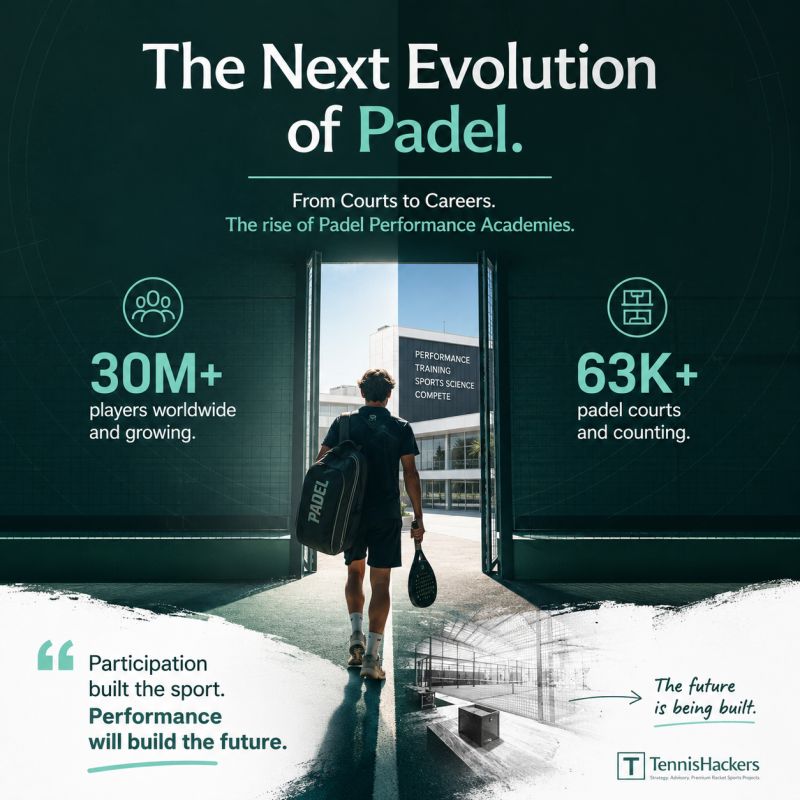
We’re not there yet, but the first generation of true Padel Performance Academies will signal that padel has evolved from a fast-growing participation sport into a mature performance sport.
Taking a look at tennis’s pathway may provide us with some indications of the journey that padel may parallel. Tennis Academies didn’t appear overnight. They emerged because there was enough participation, enough ambition, and enough parents willing to invest in long-term player development.
Padel is not at that point.
But I think it is getting much closer than many people realise.
According to industry estimates, there are now roughly 30 million padel players worldwide and more than 63,000 courts globally. Those are no longer the numbers of a niche sport. They are the foundations of an ecosystem capable of supporting structured player development, professional coaching pathways and eventually dedicated high-performance environments.
What fascinates me is that most conversations today still revolve around court construction, club memberships and social play. That’s exactly where tennis was years before academies became commonplace.
The moment a sport reaches critical mass, the next question inevitably follows:
“How do I get better?”
That question creates demand for qualified coaches, sports science, video analysis, junior pathways, strength and conditioning programmes and, ultimately, academies.
Yet I don’t think the first successful padel academies will look like traditional tennis academies. Why? welll, because whilst tennis was built around individual development, padel is fundamentally a doubles sport. Community sits at the heart of its DNA. The winning model will likely be hybrid facilities that combine thriving social ecosystems with elite player pathways. In other words, clubs first, academies second.
Interestingly, this evolution is already visible across emerging racket sports. In a recent pickleball development report, one of the most common recommendations from participants was the creation of dedicated academies and coaching centres as the sport grows.
So, participation tends to come first and performance development follows shortly afterwards.
The bigger opportunity may be even broader.
Rather than tennis academies or padel academies, perhaps the future belongs to Racket Sports Performance Academies — environments where young athletes develop movement, tactical awareness, coordination and competitive skills before specialising later in tennis, padel or pickleball.
That idea may sound ambitious today.
But then again, twenty years ago, the idea that padel would become one of the world’s fastest-growing sports sounded equally ambitious.
The industry may already be laying the foundations for its next phase of growth without fully realising it. It will be intresting to see who builds the first truly global brand in this space.
(Originally published on LinkedIn)