“Wimbledon is the easiest Grand Slam to win.”
I didn’t say it.
Former Wimbledon champion Pat Cash did. On the “Tennis With An Accent” podcast, Cash argued that Wimbledon is physically easier because the matches are shorter, the grass is softer and the climate is kinder.
At first, I thought this was a retired champion romanticising his era.
Then I researched the numbers and came away thinking:
Pat Cash is probably right..but only if we define “easy” very carefully.
Because Wimbledon may be the least physically demanding Slam.
At the same time, it may be the Slam where luck and variance play the biggest role.
Let’s start with the evidence in Cash’s favour.
Grass is still the fastest surface in tennis.
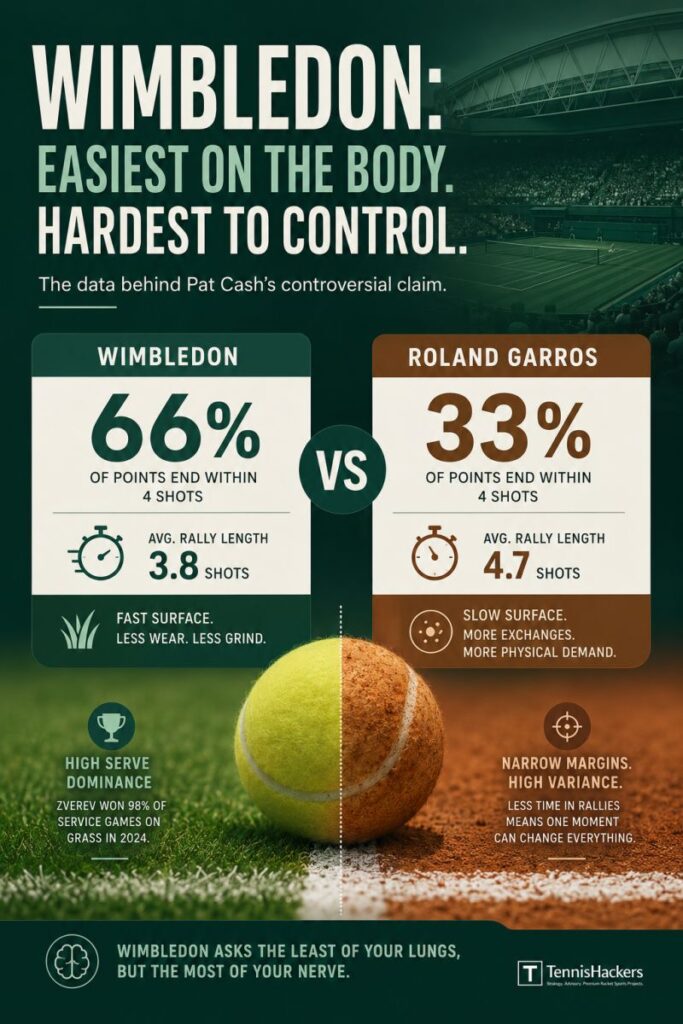
The ball skids low, players have less time to react and points finish quickly. Studies of Wimbledon match data found that around two-thirds of all points end within four shots, and the single most common rally length is just one shot: an ace or an unreturned serve. Success in these short rallies is the strongest predictor of victory.
Roland Garros is a completely different sport.
On clay, rallies average around 4.7 shots, compared with roughly 3.8 at Wimbledon. The slower surface creates higher bounces, longer exchanges and rewards endurance and patience over explosive first-strike tennis.
Which means:
At Wimbledon, you spend less time running, less time grinding, less time suffering.
Pat Cash’s first claim stands up well… so far
But here’s where things get interesting.
If rallies are shorter, there are fewer opportunities for the better player to impose their superiority. Wimbledon nudges tennis in that direction.
Because when most points end within four shots, matches become heavily dependent on a handful of moments: a return clipping the tape, a ball skidding awkwardly, a single lapse on serve.
Grass amplifies tiny edges.
The serve illustrates this perfectly.
On grass, service dominance reaches its peak.
Alexander Zverev won 98% of his service games on grass in 2024, an absurd number by historical standards. Breaking serve becomes rare, meaning one poor game can decide an entire match.
Then there is the calendar.
Players spend almost three months preparing for clay. They spend six months on hard courts.
Then suddenly they switch to grass for a season that lasts barely five weeks.
Preparation is compressed. Specialists are rare. Outcomes become more volatile.
So after digging through the research, here’s where I’ve landed.
Pat Cash is probably right that Wimbledon is the easiest Slam on the body.
The data supports him.
But “easiest on the body” is not the same thing as “easiest to win.”
Because Wimbledon is also the Slam where points are shortest, margins are smallest and randomness exerts its strongest pull.
This creates a strange paradox: could the championship that asks the least of your lung be also the one that asks the most of your nerves?
(Originally published on LinkedIn)