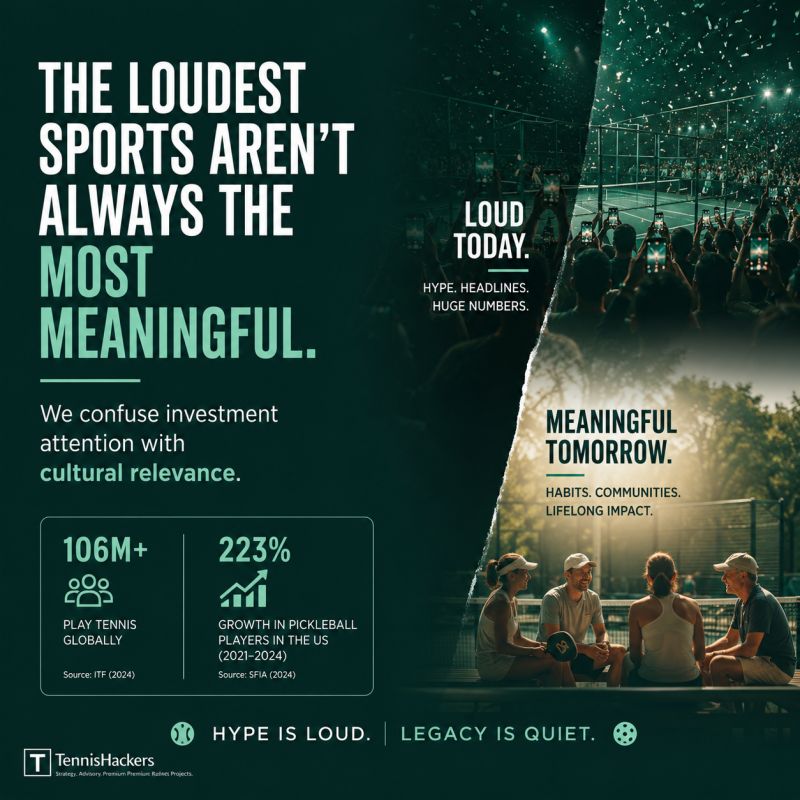
The loudest sports aren’t necessarily the most meaningful ones.
I sometimes wonder whether we confuse investment attention with cultural relevance.
A sport raises millions. Celebrities buy teams. Social media timelines fill up with highlight reels and breathless predictions about “the future”. New courts spring up everywhere… the narrative becomes inevitable.
I’ve spent the last few years immersed in tennis, padel and pickleball, speaking with operators, coaches, investors and players. And the more I learn, the less convinced I become that hype tells us very much at all.
Tennis is hardly the hottest story in sports right now. Yet it’s thriving: more than 106 million people worldwide play the sport, according to the latest global participation estimates from the International Tennis Federation. That number isn’t built on excitement. It’s built on generations of habits, traditions and communities.
Meanwhile, pickleball has become the poster child for sporting momentum. Participation in the US surged by 223% over three years to an estimated 19.8 million players, according to the SFIA – Sports & Fitness Industry Association. The growth is extraordinary.
But growth and permanence are not the same thing.
I remember visiting an old tennis club years ago. The facilities were modest. The clubhouse needed work. Nobody was talking about valuations or media rights. Yet on a rainy Wednesday evening there were juniors training, retirees playing doubles, parents having coffee and volunteers organising the weekend tournament.
Basically, the place was buzzing, because it mattered to a lot of people.
That experience shaped my thinking more than any market report ever could.
I see the same potential in padel and pickleball. Both sports are attracting investment, building infrastructure and creating excitement at an incredible pace. That’s exciting. But I think we sometimes ask the wrong questions.
How many courts are being built? How much capital has been raised? Which celebrities are investing?
Perhaps the more important questions are less sexy: Will people still play in ten years? Will clubs become communities? Will parents teach their children? Will the sport become part of someone’s identity?
Cultural relevance is difficult to measure because it grows slowly and almost invisibly. It lives in rituals, friendships and habits. It’s built one Tuesday evening league match at a time.
The sports that ultimately win are not always the loudest. They’re the ones people keep showing up for, long after everyone else has moved on.
And that’s a much harder thing to build than hype, even if we sometimes forget it.
(Originally published on LinkedIn)