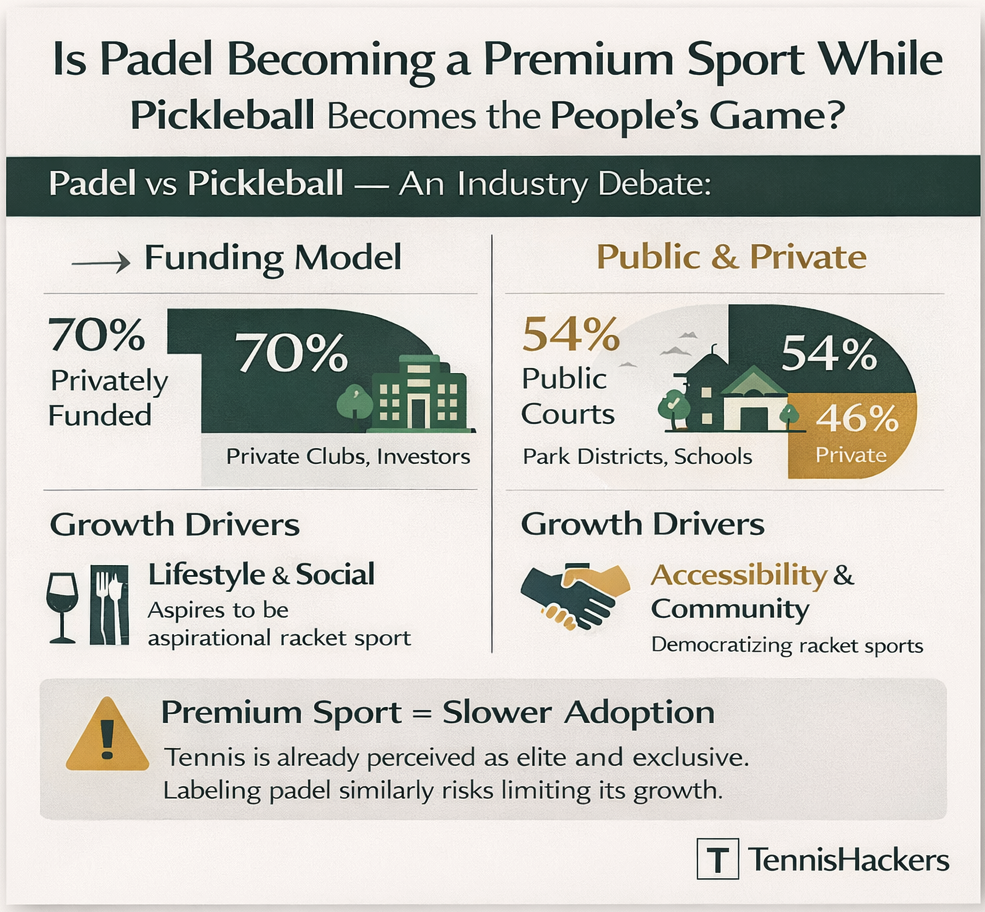
Apparently, Padel wants to become a premium lifestyle sport, whilst pickleball is turning into the sport of the people.
The more I look at the data — and compare it with what I see on the ground working around clubs and facilities — the more I think there is some truth to that.
But I also think it could become a real problem for padel if the sport leans too far into that positioning.
Roughly 70% of padel facilities worldwide are privately funded, while pickleball is spreading rapidly through parks, schools, and multi-use community spaces.
Lower build costs and easier court conversions make pickleball extremely scalable, whereas padel often grows through club models, real-estate and investor-driven projects.
You can feel this difference immediately when you visit venues.
Many padel clubs today are beautifully designed social hubs — good coffee, good food, music, events, networking, a strong lifestyle atmosphere.
Pickleball, by contrast, often appears first in community centres, municipal courts, school gyms, or temporary overlays on existing facilities.
Neither model is wrong. But they lead to very different long-term outcomes.
The risk for padel is something anyone who has spent years around tennis will recognise : once a sport starts being perceived as “premium”, participation growth usually slows down.
Not because people don’t like the sport, but because they assume it’s not for them.
Tennis has been fighting that perception for decades.
True or not, the idea that tennis belongs to private clubs has limited its reach in many markets, especially compared to sports like football, basketball, or running, where the barrier to entry feels almost zero.
Padel should be very careful not to repeat that same path.
Yes, padel should absolutely be marketed as a lifestyle sport.
Yes, the social element is one of its biggest advantages.
Yes, people love the club experience.
But lifestyle should not mean exclusive.
The fastest growth in racket sports is being driven by accessibility, sociability, and ease of play, not by prestige, tradition, or elite image.
From what I see working in this space, the venues that succeed long-term are not the ones that feel the most luxurious…they’re the ones that feel the most welcoming.
Both padel and pickleball have a huge opportunity right now to position themselves as the healthy, social, fun alternative to the old tennis club model.
Not anti-tennis — but more open, more flexible, more modern.
If padel becomes only a premium sport, it will stay niche.
If it stays social and accessible, it can scale globally.
Important to note: this positioning is not decided by federations or tours.
It’s decided by the way designers build clubs, the way operators market the sport, and the way new players feel the first time they walk onto a court.
That’s why I think this conversation matters more than it seems at first sight.
(Originally published on LinkedIn)