Founders & start-ups: you can stay. Everyone else, feel free to keep scrolling.
I get sent a lot of pitch decks.
Some of them are excellent. Many are… character-building.
After a while, you start noticing the same patterns. The difference between a good pitch and a painful one is usually not intelligence, funding, or even the idea — it’s much simpler than that: simplicity.
A few rules that would immediately improve 80% of the decks I receive:
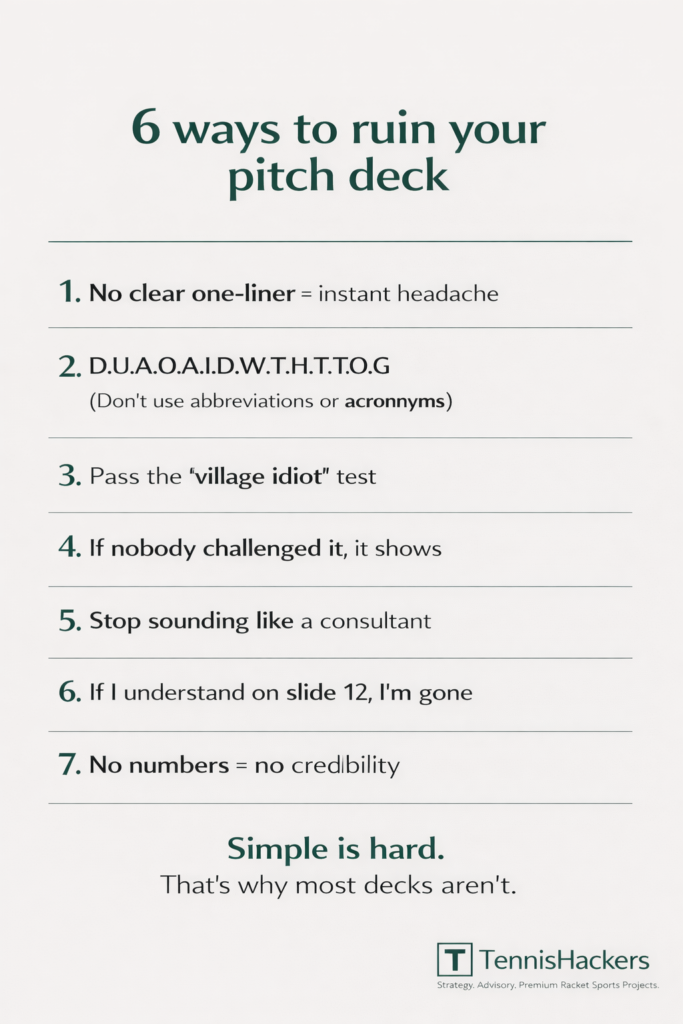
1. If you can’t explain your business in ONE SIMPLE SENTENCE on the first page, it’s the first turn-off. Not three sentences. Not a paragraph. Not a diagram with arrows going everywhere.
2. D.U.A.O.A.I.D.W.T.H.T.T.O.G *
3. Pass the “thick-as-planks” test.
Your deck should be understandable to me, a village idiot.
Always assume the reader knows nothing. Because usually, they don’t.
4. You are too close to your product, I guarantee you that. If nobody challenged your deck, it shows.
Before sending it out, show it to at least three people:
– one who understands the industry
– one who doesn’t
– one who is brutally honest
If all three understand it, you’re ready. If not, you’re not. This step alone would eliminate a shocking amount of nonsense.
5. Stop trying to sound like a McKinsey slide.
“Leveraging scalable synergies in a fragmented ecosystem” is not a business model. It’s fluff wrapped in fluff. Plain language signals confidence. Complicated language often signals the opposite.
Good decks make the problem obvious. Bad decks make the reader work.
I don’t want to have to work.
6. If slide 12 is the first time I understand what you actually do, I can guarantee you that I did not get to slide 12. Attention is not a given. It’s earned early or lost permanently.
*Don’t Use Abbreviations Or Acronyms. I Don’t Want To Have To Think Or Guess. If your pitch only makes sense to people already in your niche, you’re not pitching — you’re talking to yourself.
There’s great beauty in simplicity and the best decks feel simple.
Admitedly, simple is very hard to do. That’s why most decks aren’t….simple.
Curious to hear from others who see a lot of pitches —
what’s the one thing that immediately tells you a founder knows what they’re doing?
(Originally published on LinkedIn)