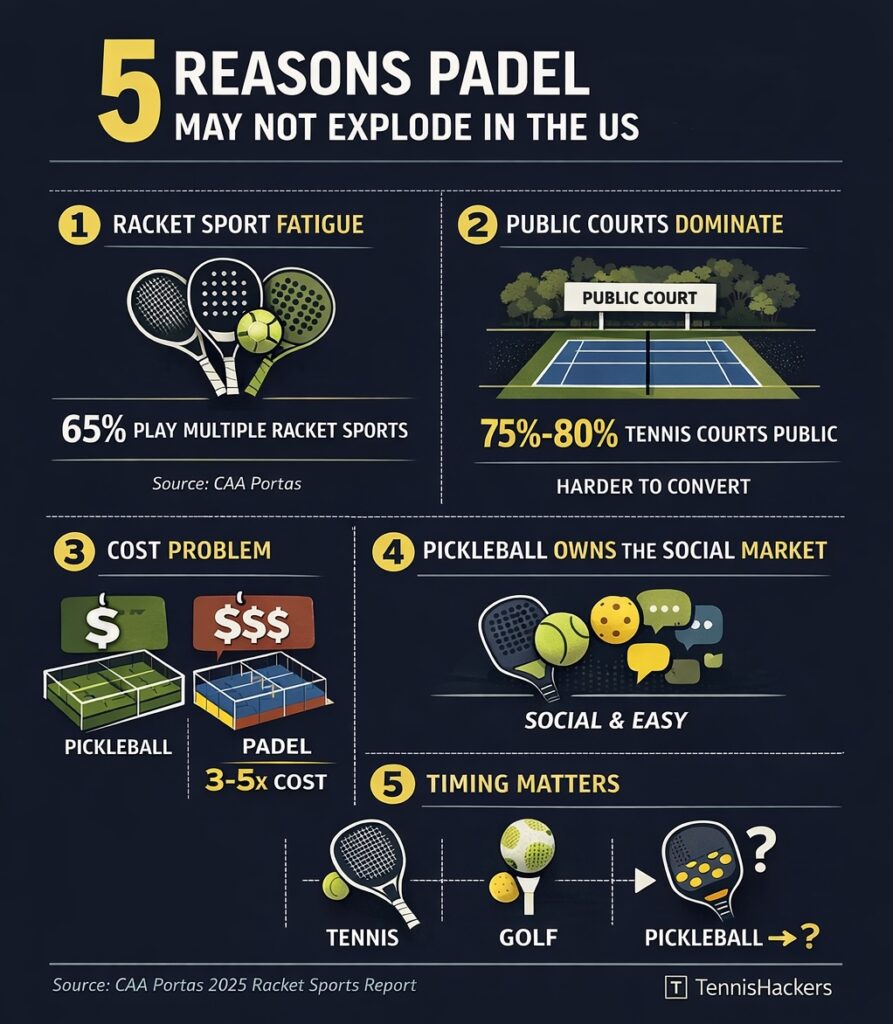
5 reasons why Padel may not take off in the US.
1. Racket Sport Fatigue:
Tennis never went away. Pickleball exploded. Platform tennis is still around. TYPTI is waiting in the wings. Now padel wants to enter the conversation as well…. the same group of players is being divided between several very similar sports.
Recent industry data suggests that roughly 60–65% of racket sport players now play more than one discipline, which sounds positive, but it also means no single sport reaches critical mass as easily (CAA Portas, 2025 report on global racket sports).
2. Money — and who controls the courts.
Across the US, municipalities have spent the last decade building pickleball courts. Those investments are recent, visible, and politically popular.
Padel courts are far more expensive to build — often 3–5× the cost of a pickleball court — and most American tennis & pickleball infrastructures are public (around 60-70%), which means slower decisions, more approvals, and more resistance to change.
Convincing local councils to fund another new racket sport won’t be easy.
3. Public facilities are running out of space:
Most parks don’t have room for another sport.
So the choices become:
– convert tennis courts
– convert pickleball courts
– build new facilities
None of those options is conflict-free.
Court conversions are already creating tension, and adding padel to the mix only increases the pressure.
I’ve seen this happen in several clubs already, and once those conflicts start, expansion slows down fast.
4. Pickleball already owns the “social & easy” space in the US
In Europe, padel filled that gap perfectly. In America, pickleball got there first. And once a sport is embedded in parks, schools and local communities, it becomes very hard to displace.
Different countries, different cultures, different outcomes.
5. Timing – padel may be arriving one boom too late…
Every sports boom cycle tends to have one big winner. In the US, it feels like tennis and golf had thier waves, and now its pickleball’s turn.
Padel is not entering an empty market.
It’s entering a market where the “new racket sport” has already been chosen.
Over the last few years I’ve been lucky to work around tennis, pickleball and padel in different countries, and one thing that keeps striking me is how much timing and local context matter. Sports don’t grow in a vacuum. They grow inside existing ecosystems, and in the US that ecosystem is already crowded.
So, expecting a Spain-style explosion might be misunderstanding how the American sports landscape really works, and history shows that markets dont always repeat themselves the way investors hope they will.
(Originally published on LinkedIn)