I’m starting to think a major threat to the racket sports boom isn’t competition between tennis, padel and pickleball. It’s injuries.
We’re living through a gold rush in racket sports, but there is a throbbing tax being paid in tendons and joints that we aren’t talking about enough.
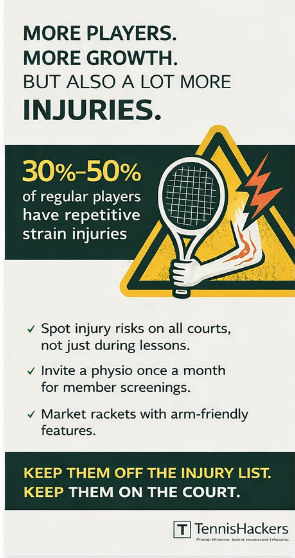
A coaching friend of mine recently told me he believes close to 40% of his regular players are dealing with some kind of repetitive strain injury — elbow, wrist, shoulder, lower back.
At first I thought that sounded exaggerated, but the data is starting to line up with the court-side reality. Studies on tennis and padel regularly report injury prevalence between 30% and 50% in recreational players, and some padel cohorts show numbers even higher, with the elbow the most common problem (Source: Journal of Sports Medicine and Physical Fitness)
Then there’s the pickleball effect. Analysts at UBS estimated pickleball-related injuries cost the US healthcare system close to $500 million in 2023, after emergency visits linked to the sport jumped sharply in recent years. When insurers see that kind of trend, they don’t ignore it — they price it in.
From a business perspective, an injured player becomes a ghost member: they don’t book courts, don’t take lessons, don’t buy grips, don’t enter events.
If even a third of your player base is playing in pain, the model leaks revenue.
But here’s my take on it: most of these injuries are not accidents. They are predictable. And very often preventable.
Which means the solution sits inside the industry.
1. Coaches need to feel responsible beyond their own lesson basket. If you see someone on the next court serving in a way that will destroy their shoulder in two years, say something. This might be the only situation where unsolicited advice is actually welcome.
2. Clubs should run injury-prevention clinics, not only technique lessons.
3. Programs should always include a warm-up and a cool-down, even if players think they don’t need one.
4. Coach education should include learning to spot mechanics that lead to chronic problems, not just how to teach a forehand.
5. Operators can do more too. What about “Member Health Days” or “Pop-Up Clinics” where you invite a physio once a month. Partner with local clinics. Offer movement screening days. It’s a small cost compared to loosing members for six months — or for good.
6. Manufacturers: Rackets are still marketed for power and spin, while shock absorption and arm-friendliness are treated like secondary features. For a lot of recreational players, those should be the headline.
We have built an industry that is very good at getting people to start playing.
We are not nearly as good at keeping them healthy enough to continue.
If we don’t start protecting the longevity of our players, the current boom in racket sports will slow down not because people lose interest — but because their elbows do.
(Originally published on LinkedIn)