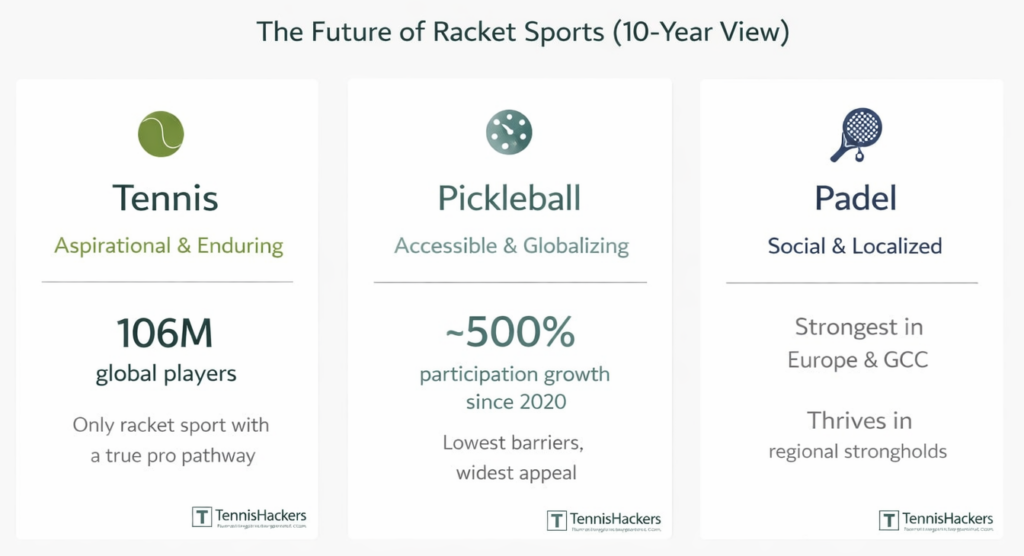
In 10 years’ time, Tennis will still be king, Pickleball will globalize, Padel will localize.
That might sound counter-intuitive in an era obsessed with fastest growth curves, but racket sports are not converging toward the same future. They’re diverging into very different roles.
Tennis, despite the noise around court conversions and participation leakage, is structurally built to survive. Its history, tradition and global prestige still matter. More importantly, it remains the only racket sport with a truly viable professional pathway. With around 106 million players worldwide, a mature global tour, Olympic status, and clear youth-to-elite pathways, tennis continues to function as an aspirational sport. And aspiration still has power.
Not everyone wants the easiest entry point — many people actively seek challenge, mastery, and progression. Tennis owns that space, and no other racket sport has come close to replicating it.
Pickleball, on the other hand, may be the sport the world didn’t know it was looking for. Since 2020, participation has grown by roughly 500%, with court numbers exploding even faster. That kind of growth isn’t driven by tradition or aspiration, but by accessibility.
Pickleball is easy to understand, cheap to build, cheap to play, highly social, and unintimidating. It attracts people who would never have joined a club, taken lessons, or considered themselves “sporty” at all.
As it expands beyond North America into schools, public spaces, and dense urban environments — particularly in Asia — it has all the ingredients to become a genuinely global participation phenomenon.
Padel sits in the most delicate position. Its rise has been spectacular, especially in markets like Spain, Argentina, Italy, Sweden, and parts of the GCC, where it has become culturally embedded and socially magnetic.
But there are already signs of fragility in some mature markets: flattening participation, oversupply of courts, and a heavy reliance on private infrastructure and social momentum.
Padel may follow a path similar to squash — once globally expansive, now thriving in strong regional pockets rather than everywhere at once. That wouldn’t make it unsuccessful, but it would make it selective rather than universal.
And finally, it’s worth remembering that the biggest disruption often comes from the margins. New formats and hybrid concepts are quietly emerging.
I recently came across LiteTennis — played on a pickleball-sized court with a foam ball, but using a full tennis racket. It slows the game down, reduces physical strain, and allows less mobile players to experience the feeling of a real tennis swing.
That’s how sports ecosystems evolve: not always by replacement, but by friction removal.
The next decade won’t be about one sport killing another. It will be about specialisation.
(Originally published on LinkedIn)