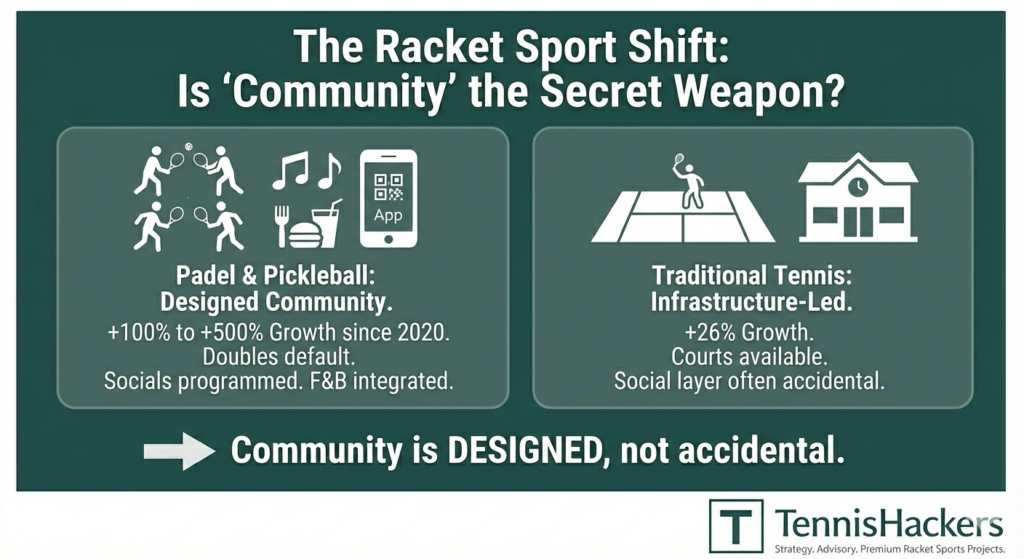
If “community” is the secret weapon of padel and pickleball, what does that make tennis?… anti-social?
It’s an uncomfortable question — and probably why it’s worth exploring.
Over the past few years, community has become the defining word around padel and pickleball. Investors swoon around it, operators build it and players feel it. And the numbers suggest something structural is happening.
According to the recent Racket Sports Race report , global racket sport participation has grown by roughly 50% since 2020. Tennis still leads with 106 million players (+26%), but padel has doubled to 30 million and pickleball has surged to 24 million (+500%).
Growth of that scale usually signals a shift in behaviour, not just hype.
Walk into a modern, successful padel or pickleball venue and you’ll notice something immediately: the court isn’t the whole product. Doubles is the default. Weekly socials are programmed. Booking systems mix players. Music plays. F&B is integrated. You can arrive alone and feel included quickly.
Community isn’t accidental. It’s designed, intentional and integrated.
There’s also clear commercial logic behind it. One tennis court can be converted into three padel courts or four pickleball courts. In some markets, that has meant three to seven times the daily revenue, with surprisingly short payback periods. More players per square metre means more density. More density means more interaction, higher retention and stronger secondary spend.
So, community has become a business model for the new racket sports.
Does that mean tennis is anti-social? Of course not. Tennis has built extraordinary communities for decades. But too often clubs have relied on tradition and infrastructure rather than deliberate activation. Courts are available, but the social layer isn’t always engineered.
And that’s where the opportunity lies.
The facilities thriving today aren’t just providing space. They are curating experiences. Hybrid hubs blending sport, hospitality and programming are outperforming static court-only models.
Tennis doesn’t need to imitate padel or pickleball. It needs to design community as intentionally as they do. Because community isn’t a marketing word.
It’s programming, density and commercial architecture working together — and the clubs that understand that will shape the next decade.
(Originally published on LinkedIn)