A friend recently asked me about the viability of setting up a pickleball facility in southern Germany — a market where the sport is still largely unknown. That question is coming up more and more, so here’s a simple way to think about viability without drowning in spreadsheets.
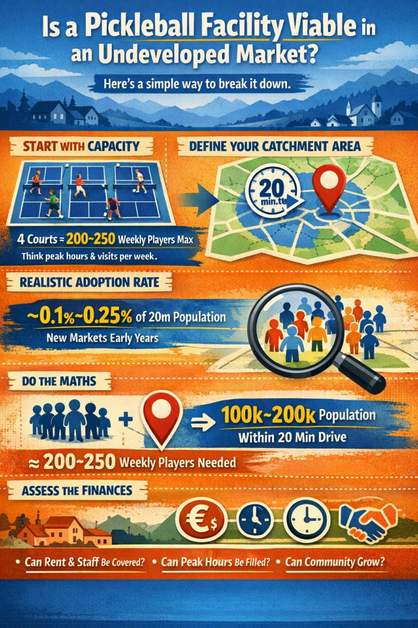
Start with capacity, not hype. A 4-court pickleball facility is realistically capped at around 200–250 weekly players once it’s running well. That assumes sensible opening hours, decent peak-time usage, and people playing 1–2 times per week. That number is your ceiling — no population model matters if you can’t fill the courts.
Next, define the real catchment. For weekly participation, a 20-minute drive is far more realistic than 30. People might travel further for tournaments or the occasional session, but regular habits are local.
Now the key assumption: in undeveloped markets, don’t expect miracles. A realistic early-stage benchmark is that ~0.1–0.25% of the 20-minute population becomes weekly players in the first few years. (0.5%+ is possible later, but it’s an upside scenario, not a starting assumption.)
Reverse the maths. If you need ~230 weekly players and only ~0.15% of the population will play weekly, you’re looking for roughly 100k–200k people within 20 minutes to make the model work.
Only after that do you ask the financial questions:
Can rent and staffing be covered by ~200–250 engaged weekly players? Can peak hours be monetised properly? Can leagues, coaching, and community increase retention?
Pickleball absolutely can work in new markets — but viability isn’t about how fast the sport is growing globally. It’s about local density, realistic adoption, and court capacity. Get those three right, and the rest becomes execution.
(Originally published on LinkedIn)