After singing Tennis’s prestige factor praises in my last post, lets keep the sport humble: I’ve lost count of how many times I’ve heard this sentence over the years:
“People don’t commit like they used to.”
It’s usually said by a tennis club manager, standing next to four empty courts on a Tuesday evening, while the padel club down the road has a waitlist and a DJ.
For a long time, tennis clubs blamed the player. Attention spans. Phones. Netflix. Pickleball. You name it, blame was assigned.
But the data — and the reality on the ground — points somewhere else.
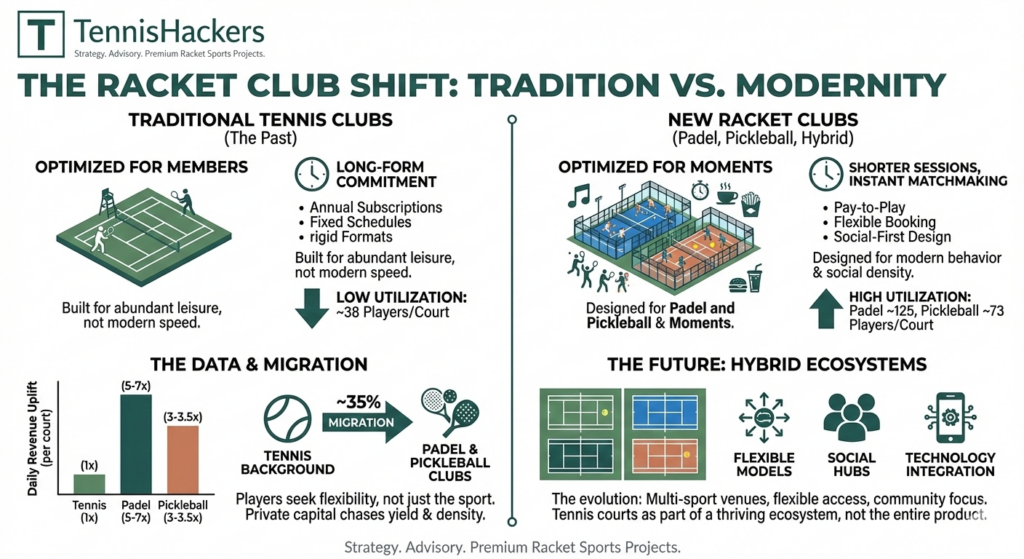
Traditional tennis clubs were built for members, not moments.
They optimized for annual subscriptions, fixed schedules, and long-form commitment. That model worked beautifully when leisure time was abundant and sport sat at the center of social life.
Then life sped up.
Padel and pickleball didn’t just grow because they’re “easier.” They grew because their clubs were designed for modern behavior.
According to the CAA Portas analysis, converting a single underutilized tennis court into padel can increase daily revenue by 5–7×. Pickleball delivers 3–3.5×. Not because the sports are superior — but because utilization explodes when friction disappears: shorter sessions, instant matchmaking, Pay-to-play, food, music, lights, and energy.
New racket clubs understand something tennis long ignored or forgot: people don’t come only to play — they come to belong.
The numbers make this painfully clear. One tennis court serves ~38 players per court globally. Padel runs at ~125. Pickleball ~73. Same square meters. Entirely different philosophy .
This is why private capital is pouring into padel and pickleball while tennis remains heavily dependent on public infrastructure. Private money chases flexibility, yield, and social density — not tradition.
And here’s the uncomfortable part for tennis purists: most of these new players used to play tennis.
The report estimates ~35% of padel and pickleball players come from a tennis background. This isn’t a hostile takeover. It’s migration — away from rigid formats and toward clubs that fit real life.
To be clear: this isn’t an obituary for tennis.
Tennis still owns prestige, pathways, youth development, and the global competitive ceiling. But at club level, it lost something quietly and early: relevance in the everyday week.
The most interesting developments I see now aren’t padel clubs replacing tennis — they’re hybrid clubs forcing tennis to evolve. Multi-sport layouts. Flexible booking. Social-first design. Tennis courts as part of an ecosystem, not the entire product.
So maybe the question isn’t why padel and pickleball are winning.
Maybe it’s this:
Did tennis clubs design for the sport they loved — or for the lives people actually live?
(Originally published on LinkedIn)