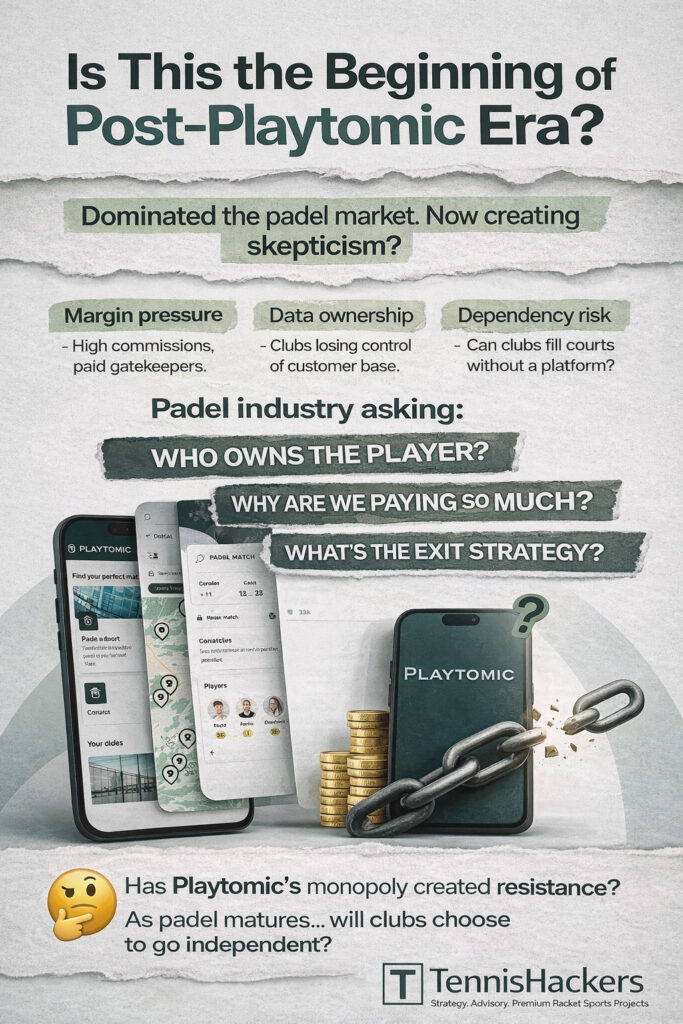
I’ve now heard from 2 large padel facilities that are walking away from Playtomic.
Not a conclusion.. it can’t even be called a pattern… yet.
For the better part of the last few years, PLAYTOMIC hasn’t just been a useful tool in padel — it has effectively become the default layer of the sport. In many markets, it’s hard to find a club that isn’t on it.
For players, it’s where you discover courts, book matches, find opponents, track games. For operators, it’s been the operating system sitting quietly underneath their entire commercial model and, being on Playtomic wasn’t really a choice — it was virtually compulsory.
But that’s exactly when things start to get interesting.
Once a platform reaches something close to monopoly-like penetration, the relationship with its users — in this case, operators — inevitably changes. What begins as enablement gradually becomes dependency. And dependency, over time, gets questioned.
The first pressure point is margin.
In the growth phase, when courts needed filling, commissions and fees were part of the deal. A fair trade: traffic and bookings in exchange for a cut. But many clubs are no longer struggling to generate demand. Courts are busy. Peak hours are full. And when that happens, operators start looking more closely at what they are giving away. The same pattern has played out in other industries with platforms like Booking.com or Uber Eats — marketplaces win scale first, then get challenged on economics later.
The second is control.
Playtomic doesn’t just process bookings — it sits between the club and the player. It owns a large part of the interaction, the data, the relationship layer. That’s fine when you’re building a market. It’s less comfortable when you’ve already built a community. Because padel, at its core, grows through social networks. People bring people. Groups become ecosystems. And at some point, operators begin to ask: why are we outsourcing access to our own players?
The third is maturity.
What we might be seeing now is not a rejection of Playtomic, but a sign that certain markets — or certain clubs — are moving into a different phase. Early-stage growth is platform-led. Mature operations tend to re-internalize key functions: direct bookings, CRM ownership, community management, pricing control. Not necessarily abandoning platforms entirely, but becoming far more selective in how they use them.
None of this suggests that Playtomic is “in trouble.” In fact, quite the opposite — you only get this kind of pushback when you’ve achieved real dominance. But dominance changes expectations. When you are the infrastructure of an industry, you are no longer judged on convenience alone, but on the value you continue to provide once the market no longer needs help standing on its own two feet.
So, if clubs don’t need platforms to fill courts… what exactly are they paying for?
(Originally published on LinkedIn)