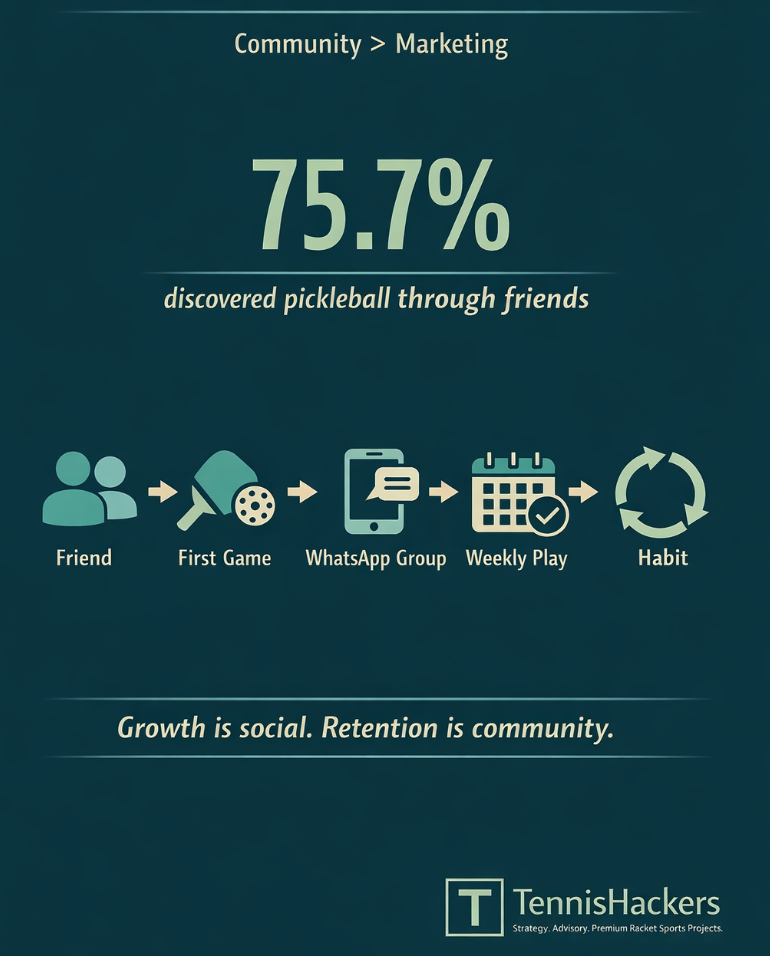
“Community is what turns people into committed players.”
I can’t remember where I recently read this, but it made me stop and think a little deeper but what it actually means in the context of padel and pickleball’s rise.
We usually explain their growth through accessibility — smaller courts, easier learning curves, lower physical demands. All true. But those factors don’t fully explain why people keep coming back, or why they start bringing others with them almost without thinking.
One stat captures it well. In a recent pickleball participation study, 76% of players said they discovered the sport through friends. Not through marketing campaigns, not through clubs or federations, but through someone they knew.
That’s not growth driven by strategy, but growth driven by social behaviour.
I’ve seen this play out repeatedly in real environments. You can have excellent courts, strong coaching, a well-designed programme — and still find that participation fades after a few sessions. People try it, enjoy it, and move on.
Then you look at a padel or pickleball court next door. Four players rotating in and out, conversations continuing between points, plans being made for the next session before the current one has even finished. It’s not just a match anymore, it’s a small social system forming around the sport.
Once that loop exists, the sport becomes secondary. What people are really coming back for is the interaction, the familiarity, the sense that there’s something waiting for them beyond just hitting balls. It’s like golf: nobody really likes the sport – it’s boring as hell, expensive, you only get to hit a few balls over several hours – but you love the banter.
This is where I think many operators get it slightly wrong. We focus heavily on supply — building more courts, refining pricing, adding booking systems, layering in technology. All important, but none of these, on their own, create attachment.
Community doesn’t scale the same way infrastructure does. You can build courts quickly but you can’t build belonging quickly.
And when that piece is missing, the numbers reflect it. A large proportion of players still only engage occasionally. Not because they don’t enjoy the sport, but because nothing is pulling them back into it consistently.
Padel and pickleball, almost by design, reduce that risk because not only are they easy to learn, more importantly they’re easy to share, easy to organise, and easy to turn into a habit with other people.
That a subtle but powerful difference.
So when we talk about “growing the game”, it might be worth shifting the focus slightly: less on how many people we can get onto a court once — and more on how many we can turn into regulars who bring others with them.
That’s where real growth starts to compound, and is free of charge.
(Originally published on LinkedIn)