Everyone says pickleball is “just a US trend.”
The numbers tell a different story.
• ~24 million players globally (2025)
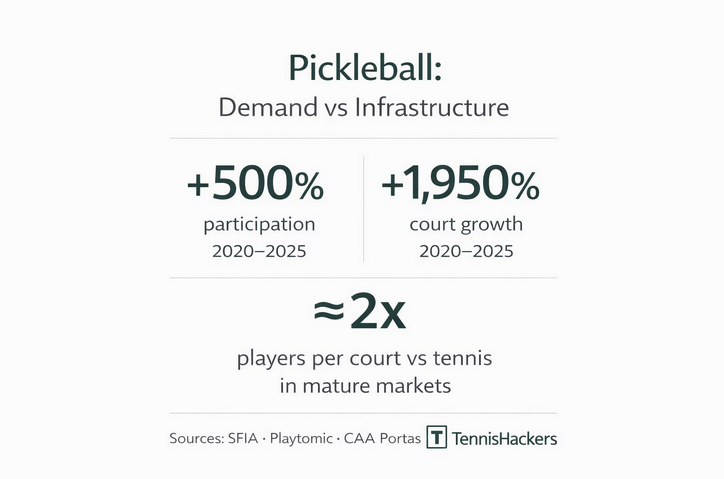
• +500% participation growth since 2020
• Court supply up ~1,950% in five years
• Still ~2× more players per court than tennis in mature markets
That combination doesn’t describe a fad.
It describes a sport that is scaling demand faster than infrastructure can keep up.
This is where most surface-level analysis falls short.
Historically, fast-growing sports don’t plateau because people suddenly lose interest.
They plateau when systems fail to absorb growth:
• Facilities lag demand
• Governance fragments
• Youth and competitive pathways remain unclear
Tennis followed the opposite path — slow participation growth, but early investment in structure, federations, pathways, and competition formats.
Pickleball has flipped that model entirely: explosive adoption first, structure second.
That creates a very specific moment in time.
On one hand, there is risk:
• Fragmented governance
• Competing tours and calendars
• Uneven facility standards across markets
On the other hand, there is opportunity:
• Countries that embed pickleball in schools early
• Cities that solve court supply creatively (overlays, multi-use, indoor hubs)
• Federations that move quickly toward legitimacy and alignment
The sports that win long-term are rarely the ones that grow the fastest first.
They’re the ones that professionalize at the right moment.
The more interesting question isn’t “will pickleball last?”
It’s who will industrialize it properly — and who will miss the window.
Do you see pickleball’s biggest risk as participation…or as structure?
(Originally published on LinkedIn)