“Pickleball is hard to monetize.”
I hear this a lot — and almost always from people looking at the wrong revenue line.
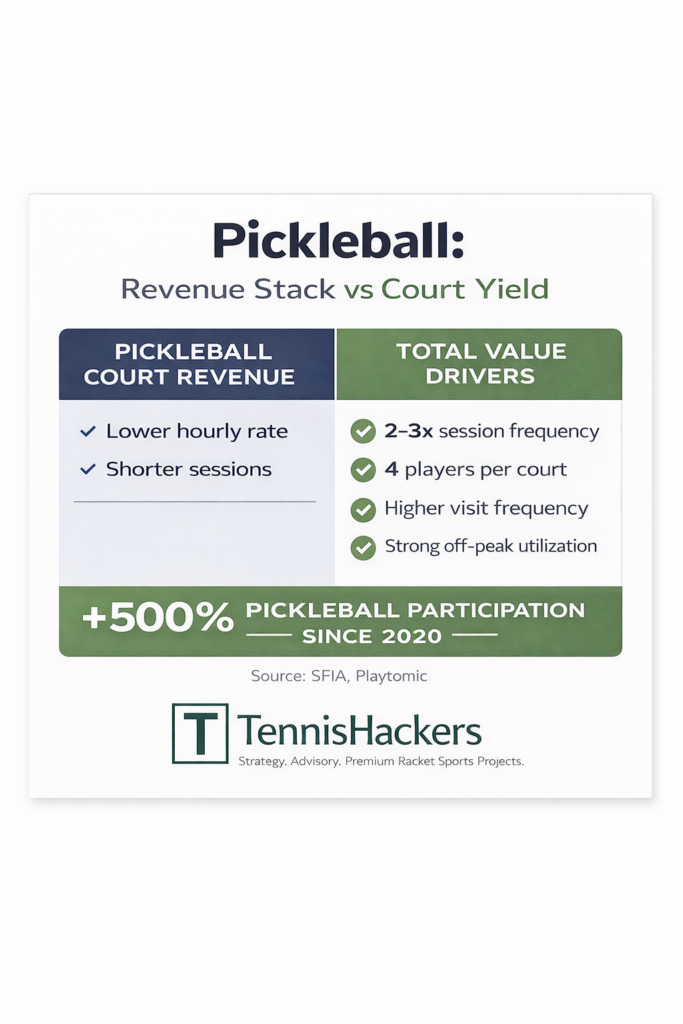
If you judge pickleball purely on court rental yield, the conclusion feels logical: lower hourly prices than tennis, shorter sessions, less “prestige” per booking.
But pickleball was never designed to win on price. It wins on frequency, density, and dwell time.
I’ve seen this firsthand in clubs where pickleball initially underperformed on paper — until operators stepped back and looked at the full revenue stack rather than just court income.
A few numbers help frame this properly.
Across multiple private facilities:
• Pickleball courts typically host 2–3× more daily sessions than tennis
• Average court occupancy is higher due to 4 players per court vs 2
• League and open-play formats drive repeat weekly usage, not occasional bookings
According to SFIA – Sports & Fitness Industry Association and PLAYTOMIC data, pickleball participation in the US has grown by ~500% since 2020, while court supply has struggled to keep pace — one reason many venues still report higher players-per-court ratios than tennis, even after rapid build-out.
What does that mean operationally?
Pickleball tends to outperform not on revenue per hour, but on revenue per member.
In several hybrid clubs I’ve reviewed:
• Pickleball players showed higher visit frequency per month
• Non-court revenue (F&B, events, socials) made up a disproportionately large share of total spend
• Off-peak utilization improved meaningfully once pickleball programming was introduced
The mistake many operators make is trying to force pickleball into a tennis-first business model. Tennis is appointment-based whilst pickleball is community-based.
One relies on yield and the other relies on lifetime value.
That doesn’t mean pickleball works everywhere, or that it’s automatically profitable.
It means it works when facilities are designed around:
• Programming instead of availability
• Membership instead of transactions
• Retention instead of peak pricing
When pickleball struggles to monetize, it’s rarely because demand isn’t there. It’s because the business model stopped at the court.
So the real question isn’t whether pickleball can make money. It’s whether we’re measuring the right kind of revenue.
(Originally published on LinkedIn)