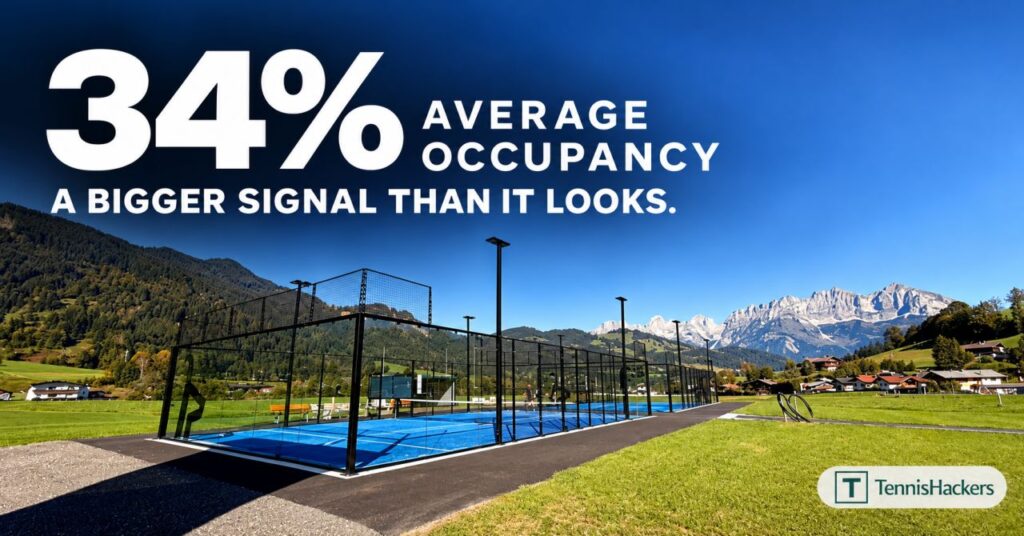
34% average occupancy. Would you open a padel facility based off that number?
Since mid-March, a two outdoor court facility close to me in Austria has recorded 1,263 bookings and 2,064 hours of play.
Good? Bad? Lets dig in because for padel operators, founders and investors, published operating data at this level is surprisingly hard to find—especially for facilities that are not part of a large, branded club network.
THE RAW NUMBERS ARE MODEST. THAT IS WHAT MAKES THEM USEFUL.
The courts are open from 7am to 10pm, seven days a week.
On that basis, the reported activity equates to around 34% average utilisation: roughly five booked hours per court per day, or 3.1 bookings per court per day. The average booking length is about 98 minutes.
No one should present that as a mature, fully optimised padel business. There is still substantial unused inventory, particularly if peak evening and weekend slots are not regularly full.
But this is not a conventional club. There is no staff, food and beverage operation, coaching programme, league calendar or social format nudging people onto court. Just two outdoor courts, a drinks machine and a few seats, in a relatively remote but affluent and tourist-oriented area.
The playable season is also limited, realistically, to mid-March through mid-November. Every one of those 1,263 bookings therefore required someone to actively choose the product: organise players, make the journey, book a slot and pay.
THAT IS THE PART I WOULD NOT UNDERVALUE.
Whenever I look at a small sports facility, I keep coming back to the same question: is demand being manufactured by programming and hospitality—or is the core product strong enough that people seek it out on its own?
Reither Wiese suggests that a simple, low-overhead facility can create meaningful organic demand before it has built the usual club machinery around it.
Using the listed rates of €30 before 6pm and €45 afterwards, the recorded 2,064 hours imply an estimated €70,176 in gross court revenue, assuming bookings are broadly distributed across opening hours. That is not audited revenue and it says nothing about profitability—but it is a valuable operating reference point.
For an operator, the next upside is clear: lift utilisation without adding much fixed cost. A beginner session, local ladder, hotel partnership, corporate offer or a simple way to find a fourth player could all convert idle hours into additional revenue.
For an investor, the lesson is equally simple: do not confuse a minimal facility with a weak one. Sometimes the courts are already enough. The opportunity is helping people play more often.
SOURCE Booking and facility information supplied by Reither Wiese, Kitzbühel. Revenue estimate calculated from stated hourly rates.
(Originally published on LinkedIn)