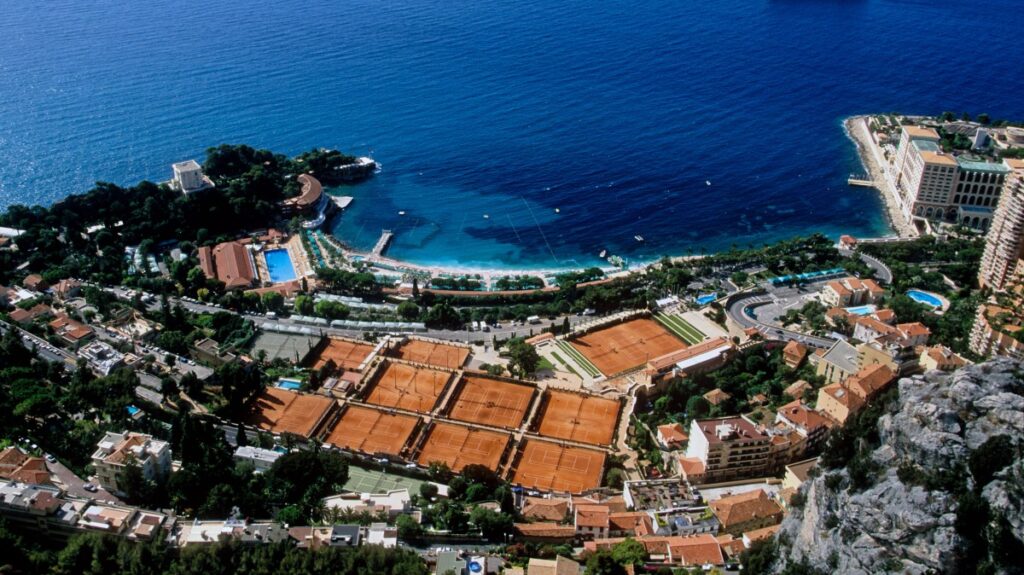
It’s hard to think of a more irrational use of land than the Monte Carlo Country Club.
Monaco is some of the most expensive real estate on earth. Depending on the source, prime land here trades anywhere between €50,000 and €100,000 per square metre. A single tennis court occupies roughly 650 m².
Do the math and you quickly realise that each court is sitting on land worth somewhere between €30 million and €65 million….per court!
And that’s before you even factor in access roads, clubhouses, seating areas, or the opportunity cost of what else could exist on that land—residential units, retail, or hospitality concepts that would generate exponentially higher returns.
Now step back for a second.
In most cities I work in, operators are fighting over whether they can justify €2–3 million for an entire site. They are squeezing in courts, cafés, gyms, recovery zones—anything that increases revenue per square metre and extends dwell time. Every square metre has to earn its keep, and if it doesn’t, it gets redesigned or removed.
And here we are, dedicating €50 million plots… to one tennis court.
It’s not a criticism – just a reality check.
Tennis in Monte Carlo exists not because it is economically efficient, but because it doesn’t have to be. It is protected by history, prestige, and a clientele that values experience over yield. It’s a luxury land use. It represents what sport looks like when space is irrelevant. Tennis owns that space in several places: think Wimbledon and Queen’s Club in London, Real Club De Tenis Barcelona, Roland Garros in central Paris – to name a few.
But most of the world doesn’t have that luxury.
In emerging markets, land is scarce, capital is tighter, and participation—not tradition—is what drives decisions. One tennis court can become three padel courts or four pickleball courts. Same footprint, multiple revenue streams, significantly lower barriers to entry, and often higher utilisation across the day, across different demographics, and across skill levels.
That’s not theory: it’s already happening across Europe, the Middle East, and increasingly in markets like India, where accessibility and infrastructure are the primary growth constraints .
And once you start looking at the numbers through that lens, the question is very simple: not “which sport is more prestigious?” but “which sport makes sense for the space available?”
So when we talk about the future of racket sports, we need to be careful where we look for signals.
Monte Carlo shows us what the sport looks like at its most beautiful for the most beautiful but it doesn’t show us what it looks like at scale.
So, if you were building a racket facility from scratch today, with no legacy, no emotion, no tradition… you probably wouldn’t start with tennis….even if part of you still wants to.
(Originally published on LinkedIn)