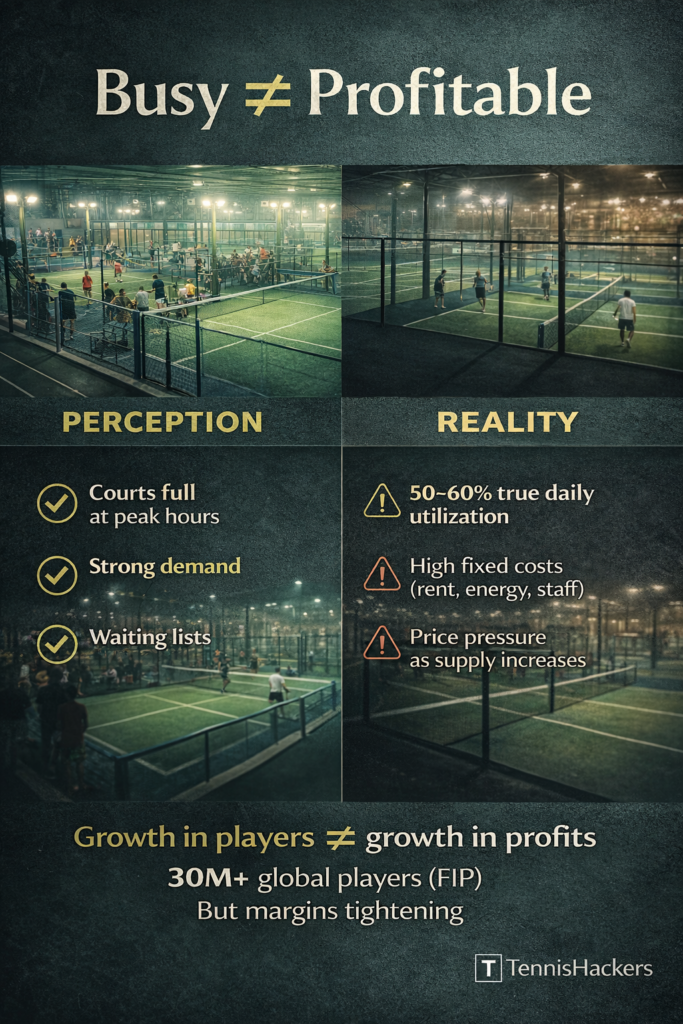
Most padel clubs are not profitable. They just don’t know it yet.
I don’t say that lightly because the market is booming. But I’ve spent enough years inside racket facilities—tennis first, now increasingly padel and pickleball—to recognise the difference between a place that feels successful and one that actually is. And right now, padel is producing a lot of the former.
Walk into almost any new club and the signs look good – if you catch it at the right time: Courts are full in the evenings. Weekends are booked out days in advance. There’s energy, noise, movement. On the surface, it looks like a booming business. I’ve had operators proudly show me their booking sheets as proof that they’ve “cracked it.”
But full courts don’t automatically mean a healthy business model. That’s the part many don’t want to look too closely at.
What I’ve started noticing in conversations—often off the record—is how tight things already are beneath that surface. Indoor facilities in particular are carrying cost bases that leave very little room for error: high rents, construction financing, rising energy costs, staffing. These aren’t marginal expenses. They define the business. And they don’t adjust when demand softens.
At the same time, pricing power is no longer what it was two or three years ago. Early operators benefited from scarcity. Today, supply is catching up quickly across Europe. According to PLAYTOMIC data and various market reports, the number of courts has grown exponentially since 2020, in some markets more than doubling. That inevitably leads to pressure on pricing—especially outside of peak hours.
That’s when the illusion starts to crack.
A club can feel busy because 6pm to 9pm is full every night. But those are only a handful of hours in a 14-hour operating day. The rest of the schedule—late mornings, early afternoons— define whether the facility is successful in the truest sense. I’ve seen facilities where effective utilisation across the full day sits closer to 50–60%, which is not enough when your fixed costs are built for a much higher break-even point.
We’ve seen this before: Sweden’s padel boom wasn’t driven by weak demand—it was driven by too much capital chasing the same opportunity too quickly. The correction that followed wasn’t a surprise. It was a delayed reality check.
None of this means padel is in trouble. Far from it. Participation continues to grow globally—estimates now point to over 30 million players worldwide (FIP). The sport itself is strong.
But the business model? That’s where the real test is just beginning.
Over the next few years, the gap between “popular” and “profitable” is going to become very visible. And the operators who survive won’t be the ones who filled courts the fastest, but the ones who understood early on that demand alone doesn’t build a sustainable business—it only hides its weaknesses for a while.
(Originally published on LinkedIn)