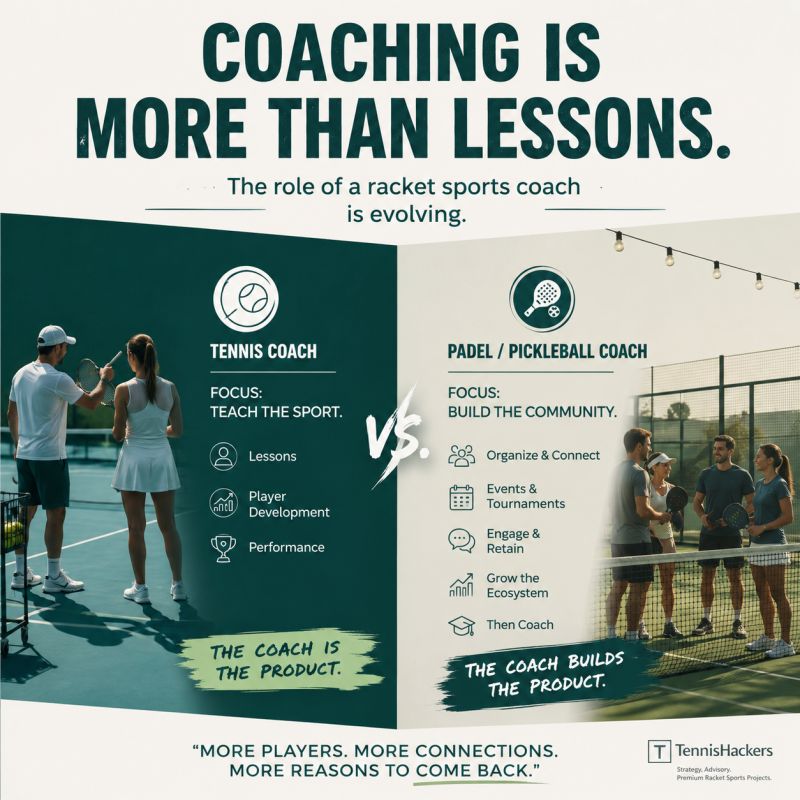
The best padel coach may not be the one who gives the most lessons.
After decades studying/working in tennis (and now pickleball and padel), this is one of the things I find most interesting about the emergence of padel and pickleball. I think we may be looking at two quite different jobs hiding behind the same word: COACH.
TENNIS
In tennis, it is entirely possible to build a career around one thing: teaching tennis.
A player books a lesson because they want to improve their forehand, fix their serve, prepare for a tournament or simply become a better player.
The ecosystem supports that model. Europe alone had 125,792 tennis coaches in 2022, serving a playing population of 23.6 million, according to Tennis Europe.
I spent most of my professional life in that world. The coach could walk onto court, close the gate and spend the next hour doing what he or she was trained to do: coach.
Having said that, the best and most valuable tennis coaches already had padel/pickleball coach instincts without knowing it… read on!
PADEL & PICKLEBALL
I think the equation is different in emerging racket sports.
Not necessarily because people don’t want coaching, but because the reason for coming to the court is often broader than improving technique.
People come to play. To meet people. To compete. To exercise. To have fun.
The pickleball research makes this particularly clear: 75.7% of respondents said they first discovered the sport through friends, rather than through traditional channels.
That changes the coach’s role.
THE NEW COACH
The really successful coach in these sports may need to become part coach, part organiser, part host, part matchmaker, part community builder and, frankly, part salesperson. That might mean any or all of the following:
– Organise the Saturday social.
– Create the WhatsApp group.
– Match four compatible players.
– Run the beginner clinic.
– Organise the tournament.
-Introduce people who might never otherwise meet.
Then, perhaps, sell them a lesson.
The coaching hasn’t disappeared. It has become part of a much bigger product.
A DIFFERENT MINDSET
This is where I think some traditional tennis thinking could struggle.
If I measure a coach’s success purely by the number of paid lessons they deliver, I may be measuring the wrong thing.
In padel and pickleball, perhaps the better barometer is:
How many people did you get playing this week who wouldn’t otherwise have played?
That is a very different job description.
And potentially a much more valuable one for a club.
The coach who creates a community doesn’t just generate lessons.
They generate participation, retention, court bookings, tournaments, memberships and ultimately revenue.
Hence, find and train coaches who understand that the future of racket-sports isn’t simply to teach the sport but to build the sport.
(Originally published on LinkedIn)