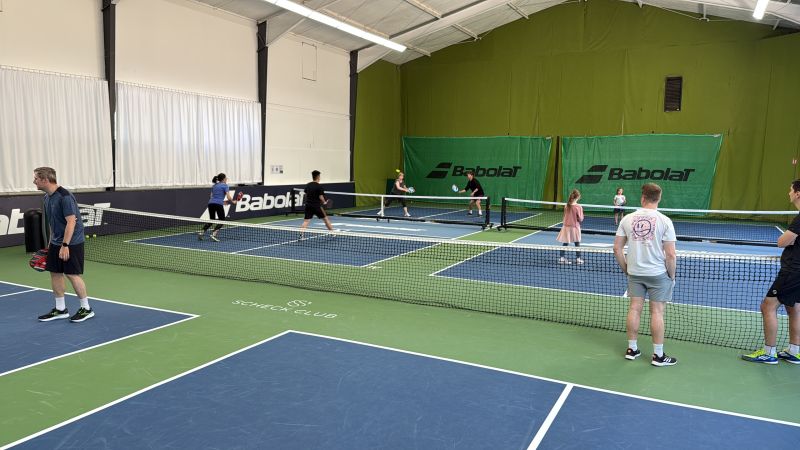
I recently attended the opening of a dedicated Pickleball facility at the enormous SportScheck centre in Munich, following the opening of another similar centre a week earlier, also in Munich – PATO Pickleball.
It made me wonder:
Can Pickleball Truly Go Mainstream in Europe?
Pickleball is booming in the United States—its blend of tennis, badminton, and ping-pong has made it one of the fastest-growing sports across age groups. But can this American-born sport replicate its meteoric rise across Europe?
The early signs are… intriguing.
🇪🇸 Spain: Pickleball Spain reports growth in cities like Madrid and Barcelona, but it still lags behind traditional racquet sports like padel, which exploded across Spain over the past two decades and enjoys significant infrastructure support.
🇬🇧 UK: Pickleball England has grown its membership base steadily and recently hosted successful international tournaments. Yet, public awareness is still limited, and most casual players discover the game only through niche clubs or expat communities.
🇦🇺 Australia: Despite a strong tennis and active-lifestyle culture, pickleball has had a slower rollout—mostly community-led and volunteer-driven. It’s growing, but not at the same viral pace seen in North America.
So what might this mean for Europe?
First, the opportunities:
– Accessibility: Pickleball is easy to learn and play, even in small urban spaces.
– Age inclusivity: It’s popular among older adults, but gaining traction with younger players too.
– Community appeal: The social, fun nature of the game resonates with the European café-culture approach to recreation.
And the challenges?
– Court availability: Existing sports infrastructure is dominated by tennis, football, and padel. Pickleball often relies on makeshift conversions.
– Cultural inertia: Many European nations have deeply entrenched sporting traditions—new entrants must fight for attention and space.
– Media & sponsorship: There’s little mainstream media coverage or corporate investment in pickleball compared to more established sports.
Historical context can guide us. Just as basketball found slow, uneven success across Europe (booming in countries like Lithuania and Spain, but remaining niche elsewhere), pickleball’s growth may mirror this pattern—a patchwork of hotspots rather than a continent-wide surge.
The question isn’t whether pickleball will exist in Europe—it already does.
The real question is: Will it evolve into a mainstream sport, or remain a recreational niche?
(Originally published on LinkedIn)